2026 Outlook: Post-Quantum Cryptography Adoption in the US

Anúncios
The 2026 outlook for post-quantum cryptography adoption in the US anticipates significant progress driven by government mandates and industry collaboration, aiming to secure critical infrastructure against emerging quantum threats.
Anúncios
The digital world is on the cusp of a monumental shift, one driven by the imminent threat of quantum computing. Understanding the landscape of post-quantum cryptography adoption in the US by 2026 is not just academic; it’s critical for national security, economic stability, and individual privacy. This article delves into the intricate details of this transition, offering an insider’s perspective on what to expect as the nation braces for a quantum-safe future.
Anúncios
The Looming Quantum Threat and the Urgency for Change
The advent of quantum computers, while promising revolutionary advancements, also poses an existential threat to current cryptographic standards. Algorithms like RSA and ECC, the bedrock of modern digital security, are vulnerable to quantum attacks. This vulnerability necessitates a proactive shift towards quantum-resistant algorithms.
The urgency stems from the ‘harvest now, decrypt later’ scenario, where encrypted data intercepted today could be decrypted by future quantum computers. This realization has propelled governments and organizations worldwide, particularly in the US, to accelerate their efforts in researching, standardizing, and adopting post-quantum cryptography (PQC) solutions.
Understanding the Quantum Threat Landscape
Quantum computers leverage principles of quantum mechanics to solve problems intractable for classical computers. Shor’s algorithm, for instance, can efficiently factor large numbers, directly undermining public-key cryptography. Grover’s algorithm can speed up brute-force attacks on symmetric-key ciphers, though the impact is less severe.
- Shor’s Algorithm: Directly threatens RSA and ECC, widely used for secure communication and digital signatures.
- Grover’s Algorithm: Reduces the effective key length of symmetric ciphers, requiring longer key sizes for equivalent security.
- Harvest Now, Decrypt Later: A critical concern where adversaries store encrypted data today, anticipating future quantum decryption capabilities.
The transition to PQC is not merely an upgrade; it’s a fundamental re-architecture of security protocols. The US government, through agencies like NIST, has been at the forefront of this effort, recognizing the profound implications for national defense, critical infrastructure, and economic competitiveness. The private sector, too, is increasingly aware of the need to protect sensitive data and intellectual property from future quantum attacks.
NIST’s Role and Standardization Efforts by 2026
The National Institute of Standards and Technology (NIST) has been the driving force behind the standardization of post-quantum cryptographic algorithms. Their multi-year process of soliciting, evaluating, and selecting quantum-resistant algorithms is a cornerstone of the US strategy. By 2026, we anticipate significant milestones in this standardization journey, directly influencing adoption rates.
NIST’s rigorous evaluation process ensures that selected algorithms are not only quantum-resistant but also practical, efficient, and secure against classical attacks. This meticulous approach is crucial for building trust and facilitating widespread deployment across various sectors.
Key NIST Milestones and Their Impact
NIST’s PQC standardization project involves several rounds of evaluation, narrowing down candidates based on security, performance, and implementation characteristics. The selection of initial algorithms marks a critical turning point for vendors and implementers.
- Algorithm Selection: NIST has already announced initial selections, such as CRYSTALS-Kyber for key encapsulation and CRYSTALS-Dilithium for digital signatures.
- Draft Standards: Expect to see more refined draft standards and recommendations for implementation by 2026, providing clearer guidance to developers.
- Community Engagement: Ongoing engagement with the cryptographic community ensures thorough vetting and promotes robust, secure solutions.
These selections provide a stable foundation upon which hardware and software vendors can begin to build and integrate PQC capabilities. The clarity provided by NIST standards is essential for reducing fragmentation and ensuring interoperability across diverse systems. By 2026, the industry will have a much clearer roadmap for which algorithms to prioritize, moving from theoretical discussions to practical deployments.
Federal Mandates and the Push for Adoption
The US government is not just supporting PQC development; it’s actively mandating its adoption across federal agencies. Presidential directives and legislative actions underscore the seriousness with which the quantum threat is being treated. These mandates are pivotal in driving the initial wave of PQC implementation.
The federal government’s vast digital footprint, encompassing everything from defense systems to civilian services, makes it a critical early adopter. Its migration efforts will serve as a blueprint and a testing ground for the private sector, highlighting best practices and potential pitfalls.
Key Legislative and Executive Actions
Several governmental initiatives are accelerating the transition to quantum-resistant cryptography. These actions provide both the impetus and the framework for federal agencies to begin their migration.
- National Security Memorandum (NSM-10): This memorandum outlines a comprehensive approach to addressing the quantum threat, including requirements for federal agencies to identify and migrate vulnerable systems.
- Quantum Computing Cybersecurity Preparedness Act: This bipartisan legislation mandates federal agencies to inventory cryptographic systems and develop migration plans to PQC.
- CISA’s Role: The Cybersecurity and Infrastructure Security Agency (CISA) is expected to play a significant role in providing guidance and resources for federal and critical infrastructure entities.
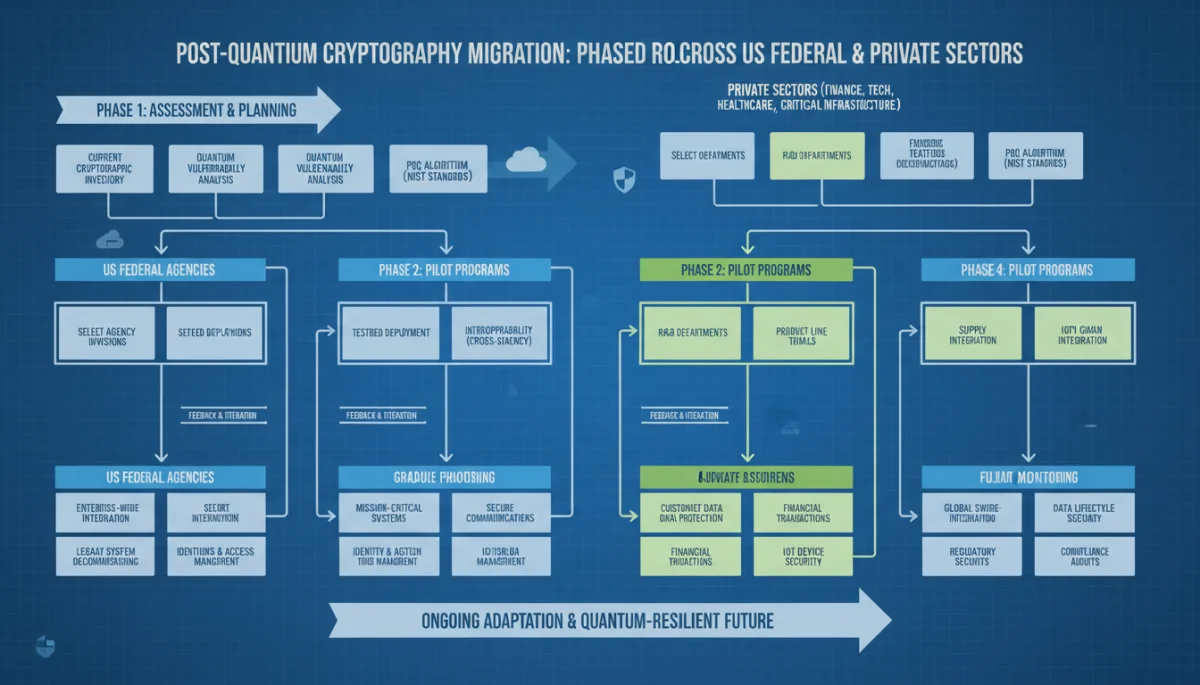
By 2026, federal agencies will be well into their assessment and planning phases, with initial pilot deployments likely underway for critical systems. This top-down approach ensures that the most sensitive data and infrastructure are prioritized, setting a precedent for broader industry adoption. The government’s commitment acts as a powerful catalyst, signaling to the market the seriousness and inevitability of this cryptographic transition.
Industry Readiness and Private Sector Challenges
While federal mandates provide a clear direction, the private sector faces its own set of challenges and opportunities in adopting PQC. The readiness varies significantly across industries, influenced by factors such as regulatory pressure, data sensitivity, and existing infrastructure complexity.
Companies must undertake a comprehensive cryptographic inventory, assess their risk posture, and develop a phased migration strategy. This is not a trivial task, especially for organizations with legacy systems and extensive global supply chains.
Obstacles and Opportunities for Businesses
The transition to PQC presents both significant hurdles and strategic advantages for businesses willing to invest early. Understanding these dynamics is key to successful adoption.
- Cryptographic Agility: Many systems are hardcoded with specific cryptographic algorithms, making updates difficult and costly. Building cryptographic agility into new and existing systems is paramount.
- Supply Chain Security: Ensuring that all components of the digital supply chain are quantum-safe requires extensive collaboration with vendors and partners.
- Talent Gap: A shortage of cybersecurity professionals with expertise in quantum cryptography poses a significant challenge for implementation and management.
By 2026, leading technology companies and those in highly regulated industries (e.g., finance, healthcare) will likely be piloting PQC solutions, especially for new products and services. Smaller businesses and those with less sensitive data may lag, but the increasing availability of PQC-ready software and hardware will eventually lower barriers to entry. The private sector’s journey will be characterized by a gradual, yet inevitable, shift as the quantum threat becomes more tangible and solutions become more accessible.
The Role of Cryptographic Agility and Hybrid Solutions
A key strategy in navigating the transition to PQC is cryptographic agility. This approach involves designing systems that can easily swap out cryptographic algorithms without requiring a complete overhaul of the underlying infrastructure. It’s about building flexibility into the security architecture.
Hybrid solutions, which combine existing classical cryptographic algorithms with new PQC algorithms, are also expected to play a crucial role. These solutions offer a pragmatic bridge during the transition period, providing an extra layer of security while confidence in PQC algorithms fully matures.
Implementing Agile and Hybrid Cryptography
The practical application of cryptographic agility and hybrid approaches involves careful planning and execution. These strategies mitigate risk and ensure continuity during the migration.
- Agile Infrastructure: Developing APIs and modular cryptographic libraries that allow for easy algorithm updates and replacements.
- Dual-Layer Security: Encrypting data with both a classical algorithm (e.g., AES-256) and a PQC algorithm (e.g., CRYSTALS-Kyber) to ensure security even if one is compromised.
- Standardization for Hybrids: NIST and other bodies are also considering how to best standardize hybrid modes to ensure interoperability and security.
By 2026, cryptographic agility will be a non-negotiable requirement for new system designs and a major focus for updating existing ones. Hybrid solutions will be widely adopted, especially in environments where the cost of failure is high and the need for immediate quantum resilience is paramount. This phased approach allows organizations to gradually build confidence in PQC while maintaining robust security against current and anticipated threats.
Global Collaboration and the Future Landscape by 2026
The challenge of post-quantum cryptography is not confined to the US; it’s a global endeavor. International collaboration in research, standardization, and implementation is crucial for ensuring a secure and interoperable global digital ecosystem. By 2026, we will see stronger international alignment on PQC strategies.
The US plays a leading role in these global discussions, influencing standards and sharing best practices. This collaboration is vital to prevent fragmentation and to ensure that cryptographic solutions are universally robust.
International Partnerships and Harmonization
Cooperation with international partners is essential for tackling a threat that transcends national borders. Harmonized standards benefit everyone by simplifying implementation and enhancing overall security.
- ISO/IEC Standards: Collaboration with international standards organizations to ensure PQC algorithms are adopted globally.
- Academic Research: Ongoing international academic collaboration to rigorously test and improve PQC candidates.
- Supply Chain Alignment: Working with international partners to secure global supply chains against quantum threats.
By 2026, the global landscape will see increased harmonization of PQC standards, with many nations aligning with NIST’s selected algorithms. This collaborative environment will accelerate the development of quantum-safe products and services, making the transition smoother and more secure for everyone. The future of cryptography is inherently global, and international cooperation is the bedrock upon which a quantum-resilient digital world will be built.
| Key Aspect | 2026 Outlook |
|---|---|
| NIST Standards | Refined draft standards and recommendations for PQC implementation widely available. |
| Federal Adoption | Federal agencies actively engaged in assessment, planning, and initial pilot PQC deployments. |
| Private Sector | Leading tech and regulated industries piloting PQC; cryptographic agility becoming standard. |
| Global Collaboration | Increased international harmonization of PQC standards and shared best practices. |
Frequently Asked Questions About Post-Quantum Cryptography Adoption
Post-quantum cryptography refers to cryptographic algorithms designed to be secure against attacks by powerful quantum computers, as well as classical computers. These new algorithms aim to replace current public-key cryptography standards like RSA and ECC, which are vulnerable to quantum attacks.
The urgency stems from the potential for future quantum computers to break current encryption, allowing adversaries to decrypt sensitive data collected today. This ‘harvest now, decrypt later’ threat necessitates proactive adoption to protect national security, critical infrastructure, and private data from future quantum attacks.
NIST is leading the standardization effort for PQC algorithms, rigorously evaluating candidates for security and efficiency. Their selections provide a critical foundation for vendors and implementers, ensuring interoperability and trust in the chosen quantum-resistant cryptographic solutions across the US and globally.
Hybrid solutions combine established classical cryptographic algorithms with new post-quantum algorithms. This approach offers a transitional layer of security, ensuring data remains protected even if one of the underlying algorithms is compromised. They provide enhanced security during the PQC migration period.
By 2026, businesses, especially in critical sectors, will be assessing their cryptographic inventory and planning PQC migration. Leading firms will pilot solutions, while cryptographic agility will become a design priority. Challenges include legacy systems and talent gaps, but early adoption offers a significant competitive advantage.
Conclusion
The journey towards widespread post-quantum cryptography adoption in the US by 2026 is complex but undeniably underway. Driven by NIST’s standardization efforts, federal mandates, and increasing awareness within the private sector, the nation is actively preparing for a quantum-safe future. While challenges remain, including the need for cryptographic agility, skilled talent, and secure supply chains, the strategic direction is clear. The collaborative efforts between government, industry, and academia, both domestically and internationally, are paving the way for a resilient digital infrastructure capable of withstanding the quantum threat. This proactive approach ensures that the US remains at the forefront of cybersecurity, safeguarding its critical assets and maintaining its technological edge in an evolving global landscape.
