Quantum Computing’s Commercial Viability by 2028: A Data-Driven Analysis
Anúncios
A data-driven analysis suggests that while significant progress is anticipated, widespread commercial viability for quantum computing by 2028 will likely be confined to niche, high-value applications rather than broad market penetration.
The promise of quantum computing has captivated imaginations, but what does a data-driven analysis truly reveal about quantum computing viability by 2028? We delve beyond the speculative headlines to examine the tangible progress, remaining hurdles, and realistic commercial prospects for this transformative technology in the next few years.
Anúncios
Understanding the Quantum Computing Landscape
Quantum computing represents a paradigm shift in computation, leveraging quantum-mechanical phenomena like superposition and entanglement to process information in fundamentally new ways. This distinct approach holds the potential to solve problems currently intractable for even the most powerful classical supercomputers, sparking immense interest and investment.
However, the journey from theoretical potential to commercial reality is fraught with significant engineering, scientific, and economic challenges. Understanding the current landscape requires a clear distinction between proof-of-concept demonstrations and scalable, error-corrected quantum systems ready for enterprise deployment.
Anúncios
Current State of Quantum Hardware
Various quantum hardware modalities are under active development, each with its own strengths and weaknesses. The race to build stable and powerful quantum processors is intense, with companies and research institutions pushing the boundaries of what’s possible.
- Superconducting Qubits: Dominant in terms of qubit count and widely adopted by IBM and Google, offering good connectivity but requiring cryogenic temperatures.
- Trapped Ions: Known for high fidelity and long coherence times, making them excellent candidates for error-correction, though scaling remains a challenge.
- Photonic Qubits: Utilize photons as qubits, potentially offering room-temperature operation and high-speed communication, but face challenges in interaction and scaling.
- Topological Qubits: Theoretical promise of inherent error resistance, but still in early research phases with no large-scale demonstrations yet.
The diversity of approaches highlights the experimental nature of the field. No single technology has emerged as a clear winner, and it is likely that different applications will benefit from different hardware types in the long run. The progress by 2028 will largely depend on which of these technologies can overcome their current limitations most effectively.
In conclusion, the quantum computing landscape is dynamic and rapidly evolving. While significant strides have been made in developing various hardware platforms, each faces unique obstacles. The next few years will be crucial in determining which of these technologies can mature sufficiently to unlock genuine commercial applications.
Key Performance Indicators for Commercial Readiness
Assessing commercial viability requires more than just raw qubit counts. Several key performance indicators (KPIs) are crucial for determining when quantum computers can transition from research tools to valuable enterprise assets. These metrics provide a more nuanced view of progress.
The ability to maintain quantum states for longer periods and perform complex operations with high accuracy are paramount. Without these fundamental improvements, even a large number of qubits will not translate into practical computational power for real-world problems.
Critical Metrics to Watch
Investors and industry observers are closely monitoring specific technical advancements that signal increasing readiness. These metrics dictate the type and complexity of problems quantum computers can tackle.
- Qubit Count and Connectivity: While not the sole indicator, a higher number of interconnected, high-quality qubits is essential for tackling larger problems.
- Quantum Volume/Circuit Depth: A holistic metric measuring the effective computational power, combining qubit count, error rates, and connectivity.
- Error Rates (Fidelity): The probability of a qubit retaining its state during an operation. Lower error rates are critical for reliable computation.
- Coherence Times: How long a quantum state can be maintained before decoherence (loss of quantum properties) occurs, directly impacting calculation duration.
Improvements in these KPIs are directly correlated with the potential for quantum systems to perform meaningful computations beyond classical capabilities. As these numbers steadily climb, the scope of problems amenable to quantum solutions expands. The focus remains on achieving fault tolerance, where errors can be corrected faster than they occur, a monumental engineering challenge.
In essence, the commercial viability of quantum computing by 2028 hinges on substantial advancements in these performance indicators. The industry is not just chasing more qubits, but better, more stable, and more interconnected qubits that can maintain their quantum properties for longer durations, thereby enabling more complex and reliable computations.
Potential Applications and Industry Impact by 2028
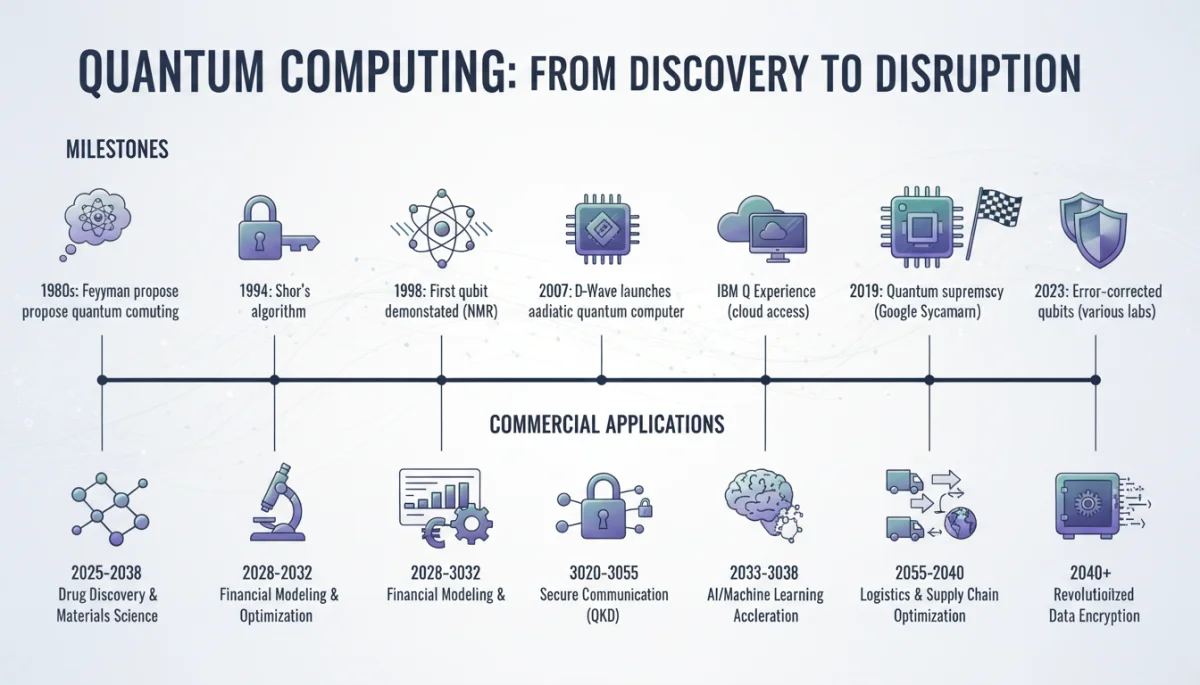
While general-purpose quantum computers are still a distant prospect, specific industries are already exploring the potential for quantum advantage in narrow, high-value applications. By 2028, we anticipate early-stage commercial impact in these targeted sectors.
The focus isn’t on replacing classical computers entirely, but on augmenting them to solve specific intractable problems. This targeted approach allows for incremental value creation, even with noisy intermediate-scale quantum (NISQ) devices.

High-Value Niche Sectors
Several industries stand to benefit from early quantum computing applications, even with the current limitations of the technology. These sectors often involve complex optimization problems or material simulations that are computationally intensive.
- Pharmaceuticals and Materials Science: Quantum chemistry simulations could accelerate drug discovery and the development of new materials with unprecedented properties.
- Financial Services: Enhanced fraud detection, optimized portfolio management, and more accurate risk modeling are potential applications.
- Logistics and Optimization: Complex supply chain optimization, route planning, and resource allocation problems could see significant improvements.
- Cryptography and Cybersecurity: While a double-edged sword, quantum computing could break current encryption standards, but also develop new, quantum-resistant cryptographic methods.
These applications are often characterized by their high computational complexity and the significant economic value derived from even marginal improvements. The initial commercial offerings will likely be quantum-as-a-service (QaaS) models, where users access quantum resources via cloud platforms, rather than owning their own quantum hardware.
By 2028, we expect to see pilot projects and early commercial deployments in these specialized areas. The impact will be incremental rather than revolutionary, but it will lay the groundwork for broader adoption as the technology matures. The focus will be on demonstrating clear, measurable quantum advantage for specific tasks.
Challenges to Widespread Adoption by 2028
Despite the exciting potential, significant hurdles remain that will prevent widespread commercial adoption of quantum computing by 2028. These challenges span technological, economic, and human capital domains, requiring concerted effort to overcome.
The complexity of building, maintaining, and programming quantum systems is immense. These are not just engineering problems, but fundamental scientific challenges that require breakthroughs across multiple disciplines.
Technological and Economic Barriers
The path to fault-tolerant, scalable quantum computers is long and arduous. The current state of quantum hardware is still largely experimental, with devices sensitive to environmental interference.
- Error Correction: Building fault-tolerant quantum computers capable of correcting errors faster than they occur is arguably the biggest technical challenge.
- Scalability: Increasing the number of high-quality, interconnected qubits while maintaining coherence and low error rates is extremely difficult.
- Cost: The current cost of developing and maintaining quantum hardware is astronomical, limiting access and widespread deployment.
- Software and Algorithms: Developing practical quantum algorithms and the software infrastructure to run them efficiently is still an active area of research.
Beyond the technical challenges, the economic case for quantum computing is still being built. The return on investment for early adopters is not always clear, especially given the significant upfront costs and the experimental nature of the technology. Furthermore, a critical shortage of skilled quantum engineers and scientists poses a significant bottleneck.
In summary, the challenges facing quantum computing’s widespread commercial adoption by 2028 are substantial. Overcoming issues like error rates, scalability, and cost, alongside developing robust software and a skilled workforce, will be crucial for the technology to move beyond niche applications. These are not trivial problems and require sustained investment and innovation.
Comparison: Quantum vs. Classical Computing in 2028
By 2028, classical computing will continue to be the backbone of global computation, maintaining its dominance across almost all applications. Quantum computing, while advancing, will primarily serve as a specialized accelerator for specific, highly complex tasks where classical methods struggle.
The relationship between quantum and classical computing will be complementary, not competitive, for the foreseeable future. Quantum systems will not replace your laptop or smartphone; instead, they will extend the capabilities of supercomputers for particular problems.
Complementary Roles
The distinction between the two computing paradigms will be clearer by 2028. Classical computers excel at a vast array of tasks, from data processing to artificial intelligence, benefiting from decades of optimization and a mature ecosystem.
- Classical Computing: Will handle the vast majority of computational tasks, benefiting from continued improvements in processing power, energy efficiency, and AI capabilities.
- Quantum Computing: Will focus on problems where quantum advantage is demonstrable, such as complex simulations, specific optimization problems, and breaking certain cryptographic schemes.
- Hybrid Approaches: Expect to see more hybrid classical-quantum algorithms, where classical computers perform most of the computation, offloading specific, quantum-intensive subroutines to quantum processors.
The development of quantum computing will likely spur innovation in classical computing as well, as researchers explore new algorithms and hardware architectures to tackle problems that might eventually be solved by quantum systems. This symbiotic relationship will drive progress in both fields.
Ultimately, by 2028, quantum computing will not have supplanted classical computing but will have carved out its own unique, albeit limited, domain of utility. Its role will be to address specific computational bottlenecks, working in tandem with classical systems to unlock new capabilities rather than replacing existing infrastructure.
Investment Trends and Ecosystem Development
Investment in quantum computing has seen a significant surge over the past few years, driven by both public funding and private venture capital. This influx of capital is fueling research, hardware development, and the growth of a nascent ecosystem of startups and established tech giants.
The global race for quantum supremacy is intensifying, with nations and corporations recognizing the strategic importance of this technology. This investment is critical for overcoming the substantial R&D costs associated with quantum systems.
Funding and Strategic Partnerships
Both governments and private entities are pouring resources into quantum technologies, signaling a long-term commitment to its development. This funding is distributed across various aspects of the quantum ecosystem.
- Government Initiatives: Major countries like the US, China, and EU nations have launched multi-billion dollar quantum programs to foster research and development.
- Venture Capital: Quantum startups are attracting substantial VC funding, focusing on hardware, software, and specific application development.
- Corporate R&D: Tech giants like IBM, Google, Microsoft, and Amazon are heavily investing in their own quantum research labs and cloud-based quantum services.
- Academic-Industry Collaboration: Strong partnerships are forming between universities and corporations to accelerate talent development and technology transfer.
The ecosystem is also expanding beyond core hardware and software to include quantum-safe cryptography, quantum sensing, and quantum networking. This broader development indicates a maturing field, even if the core computational aspect is still in its early stages. The establishment of quantum computing hubs and consortia further solidifies this trend.
In conclusion, the sustained and growing investment in quantum computing, coupled with the development of a diverse ecosystem, indicates a strong belief in its long-term potential. While commercial viability by 2028 will be limited, the current investment trends are laying the essential groundwork for future breakthroughs and broader market penetration.
| Key Aspect | 2028 Outlook for Commercial Viability |
|---|---|
| Hardware Maturity | Niche, high-performance systems for specific problems; not general-purpose. |
| Application Scope | Limited to specific, high-value use cases in finance, pharma, and materials. |
| Economic Impact | Early-stage ROI in specific sectors; significant investment but limited broad market revenue. |
| Widespread Adoption | Unlikely by 2028 due to technical hurdles, cost, and talent gap. |
Frequently Asked Questions
No, quantum computers are highly unlikely to replace classical computers by 2028. They are expected to serve as specialized accelerators for specific, complex problems that classical machines struggle with, working in a complementary hybrid fashion.
Industries like pharmaceuticals, materials science, financial services, and logistics are projected to see the most early-stage impact. These sectors have high-value problems that could benefit from quantum optimization and simulation capabilities.
The most significant challenge is achieving fault tolerance through effective error correction. Current quantum systems are highly susceptible to errors, limiting their reliability and scalability for practical, real-world applications.
For strategic, long-term R&D and niche applications, investment can be valuable. However, broad commercial returns by 2028 are expected to be limited, making it a high-risk, high-reward area for most investors.
Commercial access will primarily be through cloud-based quantum-as-a-service (QaaS) platforms. This model allows users to leverage quantum computing resources without the prohibitive costs of owning and maintaining their own quantum hardware.
Conclusion
The data-driven analysis of quantum computing viability by 2028 reveals a nuanced picture that balances immense promise with formidable challenges. While the hype often paints a picture of imminent revolution, a more realistic assessment suggests that true widespread commercial viability remains a longer-term goal. By 2028, we anticipate significant advancements in quantum hardware and software, leading to tangible, albeit niche, applications in high-value sectors such as pharmaceuticals, finance, and materials science. These early adoptions will primarily leverage quantum-as-a-service models, demonstrating quantum advantage for specific, intractable problems. However, fundamental hurdles like error correction, scalability, and the development of a robust quantum talent pool will continue to limit broad market penetration. The relationship between quantum and classical computing will remain complementary, with hybrid approaches becoming more prevalent. The sustained investment and growing ecosystem indicate a strong belief in quantum computing’s eventual transformative power, but the journey to fully realize that potential is still very much in its early stages. For now, quantum computing is a powerful tool for specific, complex computations, not a general-purpose replacement for classical systems.
