Edge AI Deployment: Overcoming Latency for US Businesses

Anúncios
Successfully deploying edge AI for US businesses demands strategic approaches to mitigate latency, ensuring real-time data processing and immediate actionable insights at the source of data generation.
Anúncios
In today’s fast-paced digital landscape, the promise of artificial intelligence at the very edge of networks is transforming how US businesses operate. The edge AI deployment latency challenge, however, remains a critical hurdle for many organizations seeking to harness real-time data processing and decision-making capabilities. This guide provides an insider’s look into navigating these complexities, offering practical strategies to ensure your edge AI initiatives not only succeed but thrive.
Understanding the Edge AI Imperative for US Businesses
The shift towards edge AI is not merely a technological trend; it’s a strategic imperative for US businesses striving for competitive advantage. By bringing AI computations closer to the data source, organizations can drastically reduce reliance on centralized cloud infrastructure, leading to faster response times and enhanced operational efficiency. This localized processing is crucial for applications where every millisecond counts, from autonomous vehicles to smart manufacturing.
Anúncios
However, the journey to effective edge AI deployment is fraught with challenges, particularly concerning latency. While the very nature of edge computing aims to reduce latency, real-world implementations often encounter bottlenecks that can compromise performance. Understanding these underlying issues is the first step toward building robust and responsive edge AI systems.
The Benefits of Localized Processing
- Reduced Bandwidth Costs: Processing data locally minimizes the amount of data sent to the cloud, significantly cutting down on bandwidth consumption.
- Enhanced Data Security: Keeping sensitive data closer to its origin reduces exposure to potential cyber threats during transmission.
- Improved Reliability: Edge systems can operate independently of constant cloud connectivity, making them more resilient to network outages.
- Faster Decision Making: Real-time analytics at the edge enables immediate responses to critical events, crucial for time-sensitive applications.
The strategic adoption of edge AI allows US businesses to unlock new levels of efficiency and innovation. From optimizing supply chains to personalizing customer experiences, the potential applications are vast. However, achieving these benefits hinges on effectively managing and mitigating latency throughout the deployment lifecycle.
Ultimately, the imperative for edge AI stems from the need for immediate insights and actions. Businesses that can process and react to data in real-time will be better positioned to adapt to market changes, improve customer satisfaction, and drive operational excellence. Recognizing this fundamental need is the bedrock upon which successful edge AI strategies are built.
Identifying Common Latency Bottlenecks in Edge AI
Even with the inherent advantages of edge computing, several factors can introduce or exacerbate latency, undermining the effectiveness of edge AI systems. Identifying these common bottlenecks is crucial for designing and implementing solutions that genuinely deliver on the promise of real-time processing.
One primary culprit is inefficient data ingestion and preprocessing at the edge. Raw sensor data often requires significant cleaning, filtering, and formatting before it can be fed into an AI model. If these initial steps are not optimized, they can become a major source of delay, negating the benefits of localized computation.
Network Infrastructure Limitations
- Suboptimal Connectivity: Reliance on unreliable or low-bandwidth local networks can introduce significant delays in data transfer between edge devices and local processing units.
- Congested Backhaul: Even when some processing occurs at the edge, aggregated data still needs to be sent to a central location or cloud for further analysis or storage, and a congested backhaul can create a bottleneck.
- Legacy Hardware: Older network equipment may not be designed to handle the high throughput and low-latency requirements of modern edge AI applications.
Another significant factor is the computational capacity of the edge devices themselves. While edge devices are becoming increasingly powerful, they still have finite resources. Running complex AI models on underpowered hardware can lead to slow inference times, directly impacting overall system latency. Proper resource allocation and model optimization are therefore paramount.
Furthermore, the communication protocols used between edge devices, local servers, and the cloud can also contribute to latency. Chatty or inefficient protocols can add unnecessary overhead, slowing down the entire data pipeline. Selecting lightweight and optimized communication methods is essential for maintaining low latency.
Understanding these bottlenecks allows businesses to proactively address potential issues during the planning and implementation phases of their edge AI projects. A thorough assessment of existing infrastructure and a clear understanding of data flow are critical steps in this diagnostic process.
Strategic Approaches to Mitigate Latency
Overcoming latency challenges in edge AI deployment requires a multi-faceted approach, combining hardware optimization, software refinements, and intelligent network design. Businesses must strategically evaluate each component of their edge ecosystem to identify and implement the most effective latency reduction techniques.
One fundamental strategy involves optimizing the AI models themselves for edge deployment. This often means employing techniques like model quantization, pruning, and knowledge distillation to create smaller, more efficient models that can run effectively on resource-constrained edge devices without significant loss of accuracy. The goal is to strike a balance between model complexity and performance.
Hardware and Software Optimization
- Specialized Edge Processors: Utilizing GPUs, NPUs, or TPUs designed for AI inference at the edge can dramatically accelerate computation.
- Optimized Operating Systems: Employing lightweight, real-time operating systems tailored for edge devices can reduce overhead and improve responsiveness.
- Efficient Data Filtering: Implementing smart data filtering and aggregation techniques at the source to send only relevant information for processing.
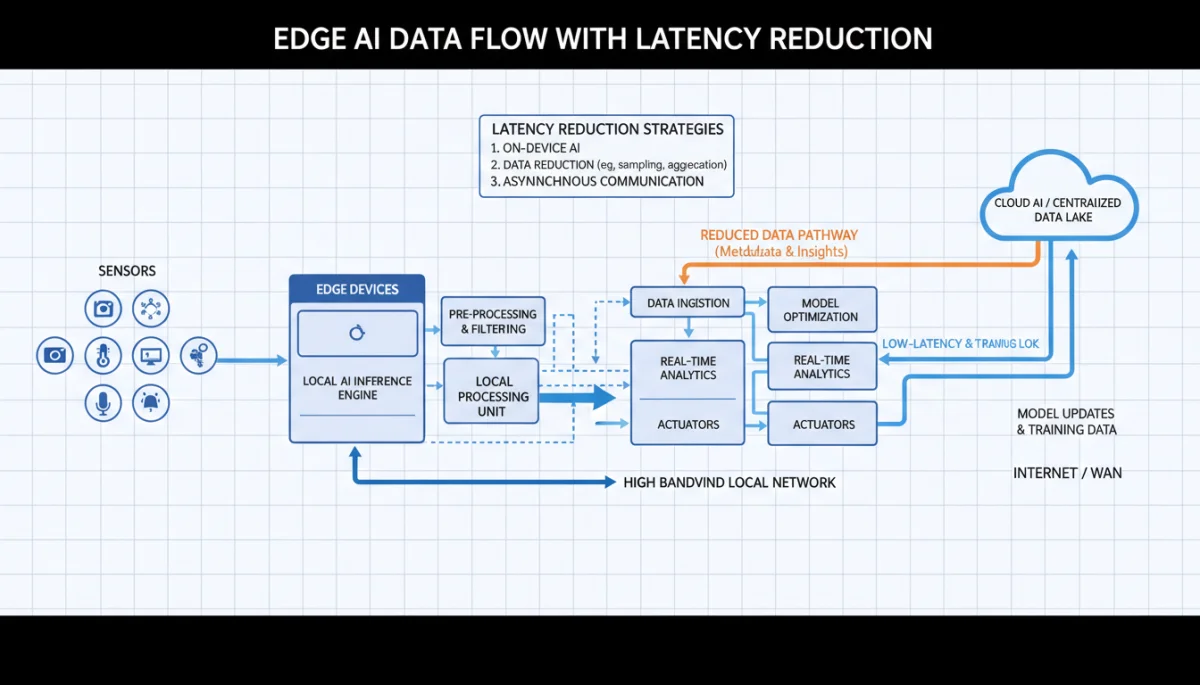

Network infrastructure plays an equally critical role. Upgrading to 5G connectivity, where available, can provide significant improvements in wireless latency. For wired connections, optimizing local area networks (LANs) with high-speed Ethernet and robust switching can ensure data moves swiftly between edge devices and local servers. Implementing Quality of Service (QoS) policies can also prioritize AI-critical traffic.
Furthermore, adopting event-driven architectures and serverless functions at the edge can minimize idle times and ensure that computational resources are only utilized when needed, contributing to overall system responsiveness. This approach helps in dynamic resource allocation based on real-time demands.
By systematically addressing these areas, US businesses can build edge AI systems that not only function but excel, delivering the real-time insights and actions necessary for modern operations. It’s an ongoing process of refinement and adaptation as technologies evolve and business needs change.
Leveraging 5G and Advanced Connectivity for Edge AI
The advent of 5G technology marks a pivotal moment for edge AI deployment, offering unprecedented improvements in speed, bandwidth, and critically, latency. For US businesses, integrating 5G into their edge strategies can unlock new possibilities and significantly enhance the performance of their AI applications.
5G’s ultra-low latency capabilities, often measured in single-digit milliseconds, make it an ideal backbone for connecting edge devices that require immediate responses. This is particularly beneficial for applications like augmented reality (AR) in manufacturing, real-time drone analytics, and connected healthcare devices where delays can have serious consequences.
Key Connectivity Innovations
- Millimeter Wave (mmWave) Technology: Provides extremely high bandwidth and low latency over short distances, ideal for dense urban environments and industrial settings.
- Network Slicing: Allows for the creation of dedicated virtual networks tailored to specific application requirements, ensuring guaranteed performance for edge AI workloads.
- Mobile Edge Computing (MEC): Integrates computing capabilities directly into the 5G network infrastructure, bringing processing even closer to end-users and devices.
Beyond 5G, other advanced connectivity solutions are also playing a role. Wi-Fi 6 and future Wi-Fi standards offer improved performance within local environments, complementing 5G’s wider area coverage. Satellite internet, especially low-Earth orbit (LEO) constellations, is also emerging as a viable option for remote edge deployments where terrestrial infrastructure is limited.
The strategic choice of connectivity depends heavily on the specific use case and geographical requirements of the edge AI deployment. A hybrid approach, combining 5G for wide-area coverage with Wi-Fi 6 for localized, high-density scenarios, often provides the most robust and flexible solution.
Ultimately, embracing these advanced connectivity options is not just about faster data transfer; it’s about enabling a new generation of real-time, highly responsive edge AI applications that can revolutionize operations across various industries for US businesses.
Security and Data Privacy at the Edge
While the focus on edge AI often centers on performance and latency, the critical aspects of security and data privacy cannot be overlooked. Deploying AI models and processing sensitive data outside the traditional data center or cloud environment introduces a unique set of challenges that US businesses must address rigorously.
Edge devices are often physically exposed, making them vulnerable to tampering or theft. Robust physical security measures, alongside strong authentication and authorization protocols, are essential to protect these distributed assets. Furthermore, securing the data in transit between edge devices and any backend systems is paramount.
Essential Security Measures
- End-to-End Encryption: Encrypting data at rest and in transit prevents unauthorized access and ensures data integrity across the edge ecosystem.
- Zero Trust Architectures: Implementing a ‘never trust, always verify’ model for all users and devices attempting to access edge resources.
- Regular Patching and Updates: Keeping edge device software and AI models updated to protect against known vulnerabilities.
- Tamper Detection: Deploying mechanisms that can detect and alert administrators to any unauthorized physical or software alterations to edge devices.
Data privacy is another significant concern, especially with regulations like CCPA in the US. Edge AI systems often process personal or proprietary information, necessitating strict adherence to privacy by design principles. Anonymization and differential privacy techniques can be employed to protect sensitive data while still allowing for valuable AI inferences.
The distributed nature of edge deployments also complicates incident response. Businesses need comprehensive monitoring and logging capabilities across all edge devices to quickly identify and address security breaches. A centralized security information and event management (SIEM) system, extended to the edge, is crucial for maintaining visibility.
By prioritizing security and privacy from the outset, US businesses can build trust in their edge AI systems and ensure compliance with relevant regulations, safeguarding both their data and their reputation. A proactive and layered security strategy is non-negotiable for successful edge AI adoption.
The Future Landscape: Edge AI and Business Transformation
The journey of edge AI is far from over; it represents a foundational shift that will continue to evolve, driving profound business transformation across various sectors in the US. As technology advances and deployment strategies mature, the capabilities of edge AI will expand, creating new opportunities and necessitating ongoing adaptation from businesses.
One key area of future development is the increasing intelligence and autonomy of edge devices themselves. We can expect more sophisticated on-device learning and adaptive AI models that can refine their performance without constant cloud intervention. This will further reduce latency and enhance the resilience of edge systems.
Emerging Trends in Edge AI
- Federated Learning: Enabling AI models to learn collaboratively from decentralized edge devices without exchanging raw data, enhancing privacy and efficiency.
- TinyML: Bringing machine learning to extremely low-power, small microcontrollers, expanding AI’s reach to even more constrained edge environments.
- Edge-to-Cloud Continuum: Seamless integration and orchestration of AI workloads across the entire spectrum, from deep edge to centralized cloud, optimizing resource utilization.
The convergence of edge AI with other emerging technologies, such as blockchain for secure data provenance and quantum computing for advanced optimization problems, will also shape its future. These synergies promise to unlock even greater potential for real-time, secure, and highly intelligent operations.
For US businesses, staying ahead in this dynamic landscape means continuously investing in research and development, fostering a culture of innovation, and building flexible, scalable edge AI architectures. The ability to quickly iterate and deploy new AI capabilities at the edge will be a significant differentiator.
Ultimately, edge AI is not just about technology; it’s about reimagining business processes, creating new services, and delivering unparalleled value to customers. Businesses that strategically embrace and adapt to this evolving paradigm will be well-positioned to lead in the intelligent, data-driven economy of tomorrow.
| Key Aspect | Brief Description |
|---|---|
| Latency Mitigation | Strategies to reduce delays in data processing and decision-making at the network edge. |
| Edge AI Benefits | Reduced bandwidth, enhanced security, improved reliability, and faster localized insights. |
| 5G Integration | Leveraging 5G’s low latency and high bandwidth for superior edge AI connectivity. |
| Security at Edge | Implementing robust measures for physical, network, and data privacy protection. |
Frequently Asked Questions About Edge AI Deployment
Edge AI involves deploying artificial intelligence models directly on devices at the network edge, close to data sources. It’s crucial for US businesses to enable real-time processing, reduce latency, enhance data security, and operate efficiently without constant cloud reliance, driving competitive advantage and innovation.
Latency, or delay, significantly impacts edge AI by slowing down data processing and decision-making. High latency can render real-time applications ineffective, leading to missed opportunities, operational inefficiencies, and compromised safety in critical scenarios like autonomous systems or industrial automation.
Key strategies include optimizing AI models for edge devices, upgrading network infrastructure with 5G or Wi-Fi 6, implementing efficient data filtering, and utilizing specialized edge processors. These measures ensure data is processed quickly and decisions are made in near real-time at the source.
Security is challenging for edge AI because devices are often physically exposed and distributed, increasing vulnerability to tampering and theft. Additionally, protecting data in transit and ensuring privacy compliance, such as with CCPA, requires robust encryption, zero-trust architectures, and continuous monitoring across all edge nodes.
5G will profoundly influence edge AI by providing ultra-low latency and high bandwidth, enabling more sophisticated real-time applications. It facilitates mobile edge computing (MEC) and network slicing, bringing processing even closer to devices and ensuring dedicated, high-performance connectivity for critical AI workloads, transforming various industries.
Conclusion
Successfully navigating the complexities of edge AI deployment, particularly in overcoming latency challenges, is paramount for US businesses aiming for sustained growth and innovation. By strategically addressing hardware, software, network, and security considerations, organizations can unlock the full potential of real-time data processing and intelligent decision-making at the source. The journey demands a proactive and adaptable approach, ensuring that edge AI systems are not only robust and efficient but also secure and compliant, paving the way for a transformative future across industries.
