3-Month Horizon: Navigating New FCC Regulations for 6G Spectrum

Anúncios
The upcoming three months are crucial for understanding new FCC regulations concerning 6G spectrum in the US, profoundly impacting the future of wireless technology and its applications.
The dawn of 6G technology promises a revolution in connectivity, far surpassing the capabilities of its predecessors. As this next-generation wireless standard approaches, the regulatory landscape is rapidly evolving. Over the next three months, understanding FCC 6G spectrum regulations in the US will be paramount for innovators, industry leaders, and consumers alike.
Anúncios
Understanding the 6G Promise and Regulatory Challenges
6G is poised to redefine our digital interactions, offering unprecedented speeds, ultra-low latency, and massive connectivity. This leap forward will enable truly immersive experiences, advanced AI integration, and the widespread deployment of autonomous systems. However, realizing this vision hinges on effective spectrum allocation and robust regulatory frameworks.
The Federal Communications Commission (FCC) plays a pivotal role in this evolution, tasked with managing the nation’s airwaves to foster innovation while ensuring fair access and national security. The challenges are multifaceted, encompassing technical complexities, economic considerations, and international coordination.
Anúncios
The Technical Landscape of 6G Spectrum
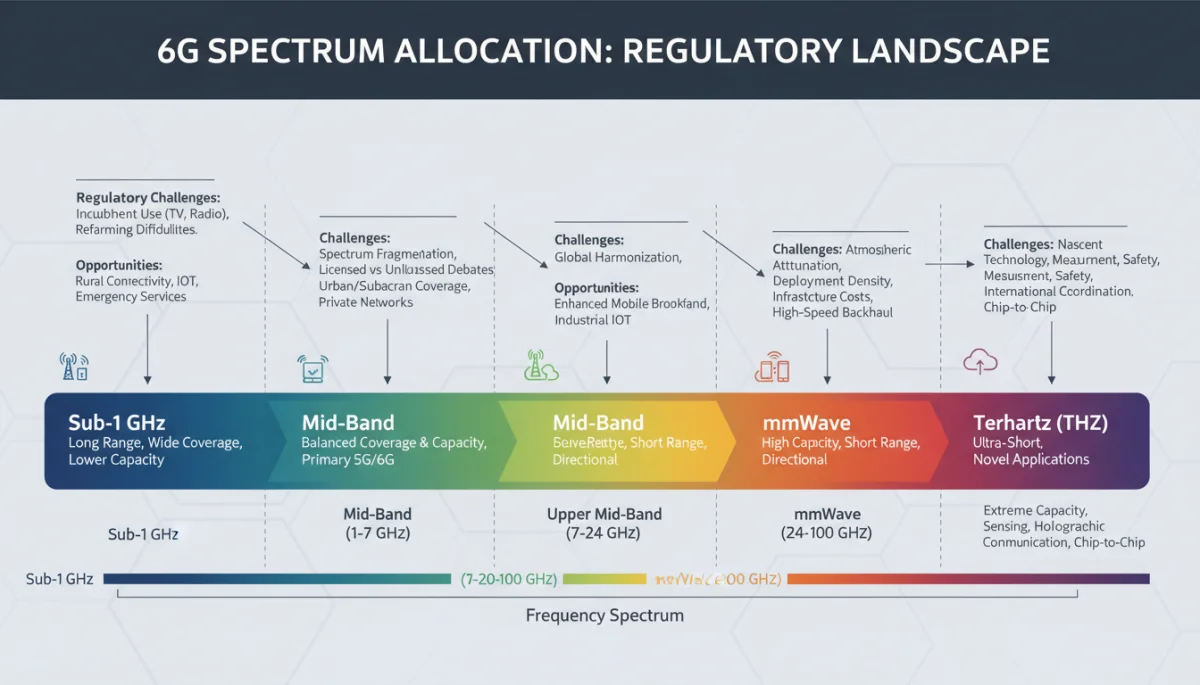
6G will likely leverage a combination of existing and new spectrum bands, including sub-1 GHz, mid-band, and potentially even terahertz (THz) frequencies. Each band presents unique characteristics and challenges for deployment and regulation. The FCC must balance these technical considerations with the need for a flexible regulatory environment.
- Sub-1 GHz: Offers broad coverage, ideal for foundational layers of connectivity.
- Mid-band: Provides a balance of coverage and capacity, crucial for urban and suburban areas.
- Millimeter Wave (mmWave): Delivers extremely high speeds over shorter distances, perfect for dense urban environments and specific applications.
- Terahertz (THz): Explores uncharted territory, promising unprecedented bandwidth but facing significant propagation challenges.
The FCC’s decisions in the coming months will set the stage for how these diverse spectrum assets are utilized, directly influencing the pace and direction of 6G development in the US. The regulatory body must also consider interference management and coexistence with existing wireless services.
In conclusion, the promise of 6G is immense, but its realization depends heavily on the thoughtful and strategic navigation of regulatory challenges by the FCC. The technical intricacies of spectrum allocation are at the heart of this process, demanding careful consideration of various frequency bands and their unique properties.
Recent FCC Initiatives and Their Implications
The FCC has not been idle in preparing for the 6G era. Recent actions and proposals indicate a proactive approach to spectrum policy, laying the groundwork for future advancements. These initiatives often involve public consultations, workshops, and collaborative efforts with industry stakeholders.
One key area of focus has been identifying and clearing new spectrum bands for commercial use. This includes exploring underutilized frequencies and re-purposing others to accommodate the growing demand for wireless capacity. The commission’s recent notices of inquiry (NOIs) and proposed rulemakings (NPRMs) offer a glimpse into their strategic thinking.
Key FCC Actions and Proposals
The FCC has initiated several proceedings aimed at understanding the technical and policy implications of various frequency ranges for advanced wireless services. These include:
- Exploring the Upper Mid-band: Investigations into spectrum between 7 GHz and 24 GHz, which could offer a sweet spot for 6G deployment, balancing coverage and capacity.
- Terahertz Spectrum Research: Support for research and development in the THz bands (above 100 GHz), acknowledging their potential for ultra-high-speed communication.
- Streamlining Licensing Procedures: Efforts to simplify and expedite the licensing process for experimental and commercial deployments, encouraging faster innovation cycles.
These initiatives are crucial for fostering a vibrant ecosystem for 6G innovation. By providing clarity and access to necessary spectrum, the FCC empowers researchers and developers to push the boundaries of what’s possible. The implications extend beyond just technical innovation, touching upon economic growth and global competitiveness.
Ultimately, the FCC’s recent initiatives demonstrate a clear commitment to paving the way for 6G. Their proactive stance on spectrum identification and allocation, coupled with efforts to streamline regulatory processes, is a positive sign for the future of wireless technology in the US.
The Critical 3-Month Window: What to Expect
The next three months are a crucial period for the FCC’s 6G spectrum strategy. During this time, we anticipate significant developments, including potential public notices, comment deadlines, and even initial rulemakings that will shape the future of 6G in the US. Industry players and the public should closely monitor these announcements.
This period will likely involve a deeper dive into the technical feasibility and economic impact of various spectrum allocation models. Expect to see detailed reports and analyses from both the FCC and external stakeholders, contributing to a robust public discourse on these critical issues.
Anticipated Milestones and Deadlines
Within this 3-month horizon, several key actions are expected:
- Public Comment Deadlines: The closing of comment periods for several NOIs and NPRMs related to spectrum allocation and usage for next-generation wireless.
- Workshop Summaries and Findings: Publication of summaries and key findings from recent FCC-hosted workshops on 6G technologies and spectrum.
- Initial Rulemaking Proposals: Potentially, the release of initial proposals for new rules governing specific spectrum bands deemed critical for 6G.
These milestones are not just bureaucratic procedures; they represent critical junctures where stakeholders can influence the regulatory direction. Active participation from industry, academia, and consumer groups is vital to ensure that the FCC’s decisions are well-informed and serve the broader public interest.
The decisions made within this 3-month window will have long-lasting effects, determining which spectrum bands are prioritized, how they are shared, and the overall regulatory burden on innovators. Staying informed and engaged during this period is essential for anyone invested in the future of 6G.
Impact on Industry and Consumers
The impending FCC regulations for 6G spectrum will have profound implications for both the telecommunications industry and everyday consumers. For industry players, these regulations will dictate investment strategies, research and development priorities, and competitive landscapes. For consumers, the outcome will directly influence the availability, cost, and quality of future wireless services.
Telecommunications companies, equipment manufacturers, and content providers are all watching closely. Clear and predictable regulatory frameworks are essential for fostering the massive investments required to build out 6G networks. Uncertainty can lead to delays and hesitation in bringing new technologies to market.
Industry Perspectives and Challenges
The industry faces several challenges and opportunities:
- Investment Certainty: Clear spectrum policies provide the confidence needed for companies to invest billions in infrastructure and R&D.
- Competitive Landscape: How spectrum is allocated can significantly impact market competition, favoring some players over others.
- Global Harmonization: US regulations also influence global standards and interoperability, a crucial factor for international companies.
Consumers stand to benefit from enhanced connectivity, new services, and improved digital experiences. However, the cost of these advancements and equitable access across different demographics will be key considerations. Regulators must ensure that the benefits of 6G are broadly distributed.
Ultimately, the FCC’s decisions will shape the competitive dynamics of the wireless industry, driving innovation and potentially lowering costs for consumers through increased competition. A balanced regulatory approach is key to unlocking the full potential of 6G for all stakeholders.
Global Context and International Cooperation
While the FCC focuses on domestic spectrum policy, the development of 6G is inherently a global endeavor. International cooperation and harmonization of spectrum allocations are critical to ensure seamless global connectivity, foster economies of scale, and prevent fragmentation of the wireless ecosystem. The US plays a significant role in these global discussions.
Organizations like the International Telecommunication Union (ITU) facilitate these international dialogues, aiming to establish common standards and spectrum bands for future wireless technologies. The FCC’s decisions often reflect, and in turn influence, these broader international trends.
The Role of International Bodies
International cooperation is vital for:
- Standardization: Ensuring devices can operate across different countries without compatibility issues.
- Economies of Scale: Larger markets for equipment drive down costs for manufacturers and consumers.
- Avoiding Interference: Coordinating spectrum usage across borders to prevent harmful interference.
The US, through the FCC and other agencies, actively participates in these international forums, advocating for policies that align with national interests while promoting global technological advancement. The decisions made by the FCC in the coming months will be closely watched by regulators and industry leaders worldwide.
Therefore, the FCC’s regulatory approach to 6G spectrum is not isolated; it is part of a larger global effort to define the future of wireless communication. Harmonizing domestic policies with international standards will be crucial for the widespread success and adoption of 6G.
Preparing for the 6G Future: Recommendations and Outlook
As the 3-month horizon for new FCC regulations approaches, preparedness is key for all stakeholders. For businesses, this means actively engaging with the regulatory process, conducting internal assessments of potential impacts, and strategically planning for future spectrum needs. For consumers, staying informed about these developments will help understand the trajectory of future wireless services.
The outlook for 6G is incredibly promising, with the potential to transform numerous aspects of our lives, from healthcare and education to entertainment and manufacturing. However, realizing this potential requires a collaborative effort between regulators, industry, and the public.
Strategic Recommendations for Stakeholders
To navigate the evolving 6G landscape effectively:
- Active Engagement: Participate in FCC public comment periods and workshops to voice perspectives and concerns.
- Technology Roadmapping: Align internal R&D and product development with anticipated spectrum availability and regulatory frameworks.
- Partnerships: Collaborate with other industry players and research institutions to pool resources and expertise.
The FCC’s role in this transition is not just about setting rules; it’s about fostering an environment where innovation can thrive responsibly. Their commitment to a transparent and inclusive regulatory process is vital for building trust and ensuring broad support for 6G initiatives.
In conclusion, the 6G future is bright, but its path is being forged now through critical regulatory decisions. By understanding and actively participating in the process, stakeholders can help ensure that the US remains at the forefront of wireless innovation, delivering a truly transformative 6G experience.
| Key Aspect | Brief Description |
|---|---|
| 6G Promise | Unprecedented speeds, ultra-low latency, and massive connectivity for immersive experiences and AI integration. |
| FCC Role | Manages US airwaves, allocates spectrum, and sets regulations to foster innovation and ensure fair access. |
| 3-Month Horizon | Critical period for potential public notices, comment deadlines, and initial rulemakings shaping 6G spectrum. |
| Global Context | International cooperation and harmonization are crucial for seamless global 6G connectivity and economies of scale. |
Frequently Asked Questions About 6G Regulations
6G represents the next generation of wireless technology, promising significantly faster speeds, lower latency, and greater capacity than 5G. New regulations are essential to allocate and manage the vast spectrum required for 6G, prevent interference, ensure fair access, and foster innovation effectively.
FCC regulations will directly influence the pace and direction of 6G development by determining available spectrum bands, licensing procedures, and technical standards. Clear and predictable policies are crucial for industry investment, fostering competition, and ensuring the widespread adoption of 6G technologies.
6G is expected to utilize a wide range of spectrum bands, including sub-1 GHz for broad coverage, mid-band for balanced performance, millimeter wave (mmWave) for high-capacity applications, and potentially even terahertz (THz) frequencies for ultra-high bandwidth. The FCC is actively exploring these options.
Stakeholders, including industry, academia, and the public, can contribute by submitting comments to FCC Notices of Inquiry (NOIs) and Proposed Rulemakings (NPRMs). Participating in workshops and engaging with advocacy groups are also effective ways to influence policy decisions and ensure diverse perspectives are heard.
While 6G deployment is still several years away, the next three months are critical for foundational regulatory decisions. We anticipate public comment deadlines, workshop summaries, and potentially initial rulemaking proposals from the FCC, setting the stage for future spectrum allocation and policy development.
Conclusion
The journey towards 6G is a complex yet exhilarating one, with the next three months representing a pivotal phase for regulatory clarity in the US. The FCC’s diligent work in navigating the intricacies of spectrum allocation will directly shape the future of connectivity, impacting everything from national innovation to global competitiveness. By fostering an environment of informed discussion and strategic planning, the US can ensure it remains a leader in the next generation of wireless technology, delivering transformative benefits to both industry and consumers.
