Setting SMART Goals for 2026: Your Path to Personal Success in the US

Anúncios
The SMART framework is crucial for personal success in 2026 across the US, guiding individuals to define Specific, Measurable, Achievable, Relevant, and Time-bound goals, ensuring clarity and motivation for impactful achievements.
Are you ready to make 2026 your most successful year yet? The journey to achieving your aspirations in the United States begins with a clear, actionable plan. This article will guide you through Setting and Achieving Goals: The SMART Framework for 2026 Personal Success in the US, providing practical strategies to turn your dreams into reality.
Anúncios
Understanding the SMART Framework for Goal Setting
The SMART framework is a widely recognized methodology that helps individuals and organizations set clear, attainable goals. It transforms vague aspirations into concrete plans, making the path to achievement much clearer. For anyone in the US aiming for personal growth in 2026, understanding and applying SMART principles is foundational.
This approach ensures that each goal is well-defined, trackable, and realistic, fostering a sense of purpose and direction. Without a structured approach like SMART, goals often remain as mere wishes, lacking the necessary components for successful execution. Let’s delve into each component to see how it can empower your 2026 ambitions.
Anúncios
What does SMART stand for?
Each letter in SMART represents a crucial criterion for effective goal setting. These criteria work in tandem to create a robust framework that supports intentional planning and sustained effort. Dissecting each element helps in crafting goals that are not only inspiring but also genuinely achievable within the given timeframe.
- Specific: Clearly define what you want to achieve.
- Measurable: Establish criteria for tracking progress.
- Achievable: Ensure the goal is realistic and attainable.
- Relevant: Align the goal with your broader objectives.
- Time-bound: Set a clear deadline for completion.
By adhering to these principles, individuals can avoid common pitfalls like procrastination or feeling overwhelmed by overly ambitious or ill-defined targets. The SMART framework provides a roadmap, guiding you from inception to successful completion of your personal goals.
Making Your Goals Specific and Measurable for 2026
Specificity and measurability are the cornerstones of effective goal setting within the SMART framework. A specific goal answers the ‘who, what, where, when, why, and how’ of your objective, eliminating ambiguity and providing a clear target. For 2026 personal success in the US, this means moving beyond general desires to concrete intentions.
For instance, instead of saying “I want to get fit,” a specific goal might be “I want to run a 10K race by October 2026.” This level of detail provides a clear picture of what needs to be accomplished and sets the stage for action. It’s about painting a vivid mental image of your desired outcome.
Defining specific objectives
To make your goals specific, consider the exact outcome you envision. What will it look like when you achieve it? How will you know you’ve reached it? These questions help in drilling down to the core of your ambition. Specificity also helps in identifying the resources and steps needed to move forward effectively.
- Clearly state the desired outcome.
- Identify the exact actions required.
- Pinpoint any necessary resources or support.
Once a goal is specific, making it measurable becomes the next crucial step. Measurable goals allow you to track your progress, celebrate milestones, and stay motivated. Without a way to measure, it’s impossible to truly know if you are moving closer to your objective or if adjustments are needed.
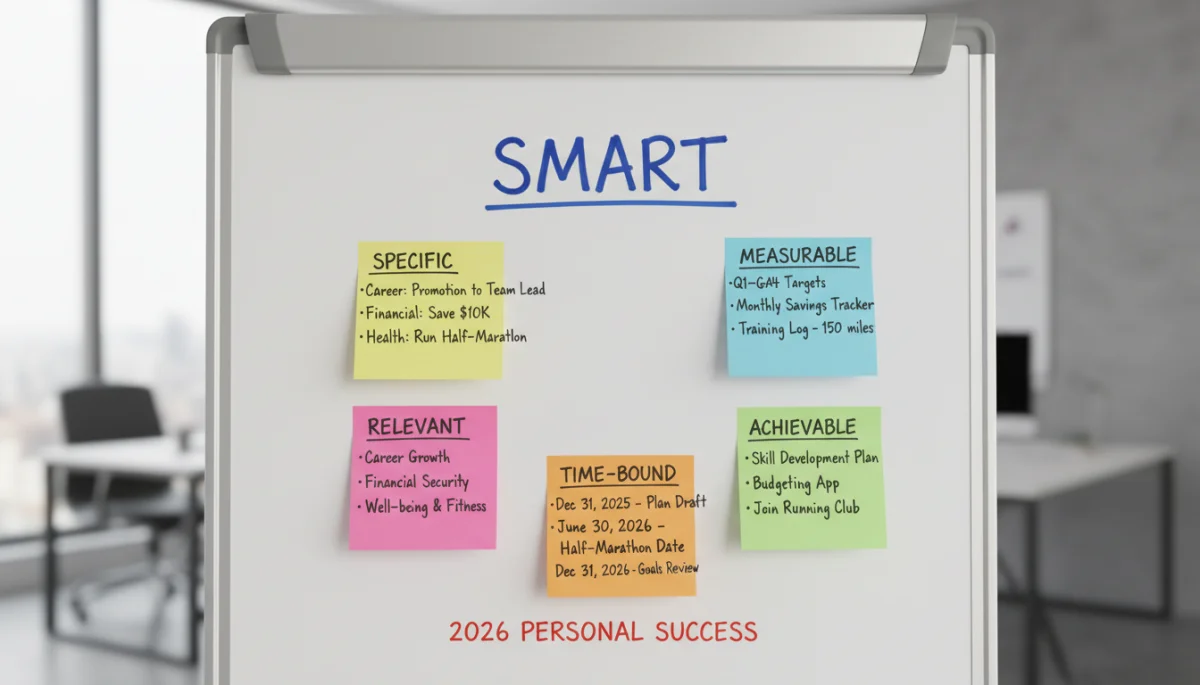
Measuring progress can involve quantifiable metrics such as numbers, percentages, or frequencies. For the 10K race goal, measurements could include weekly mileage, pace improvements, or successful completion of training runs. These metrics provide tangible evidence of your efforts and proximity to success.
The combination of specific and measurable elements creates a robust foundation for your 2026 personal goals. It transforms abstract desires into actionable plans, providing both clarity and a means to gauge your success throughout the year. This precision is what often differentiates successful goal achievement from mere wishful thinking.
Ensuring Your Goals Are Achievable and Relevant
Setting goals that are both achievable and relevant is vital for maintaining motivation and ensuring your efforts are well-placed. An achievable goal is one that you can realistically accomplish within the given constraints and resources. While it’s good to aim high, setting impossible goals can lead to frustration and burnout.
Consider your current skills, available time, and financial resources when determining if a goal is achievable. For 2026 personal success in the US, this means assessing your personal capacity and external factors. It’s about finding that sweet spot between challenging yourself and setting yourself up for success.
Assessing achievability
To assess achievability, ask yourself if you have the necessary tools, knowledge, and support. If not, can you acquire them? Breaking down a large goal into smaller, manageable steps can also make it feel more achievable. This incremental approach builds confidence and momentum.
- Evaluate your current resources and capabilities.
- Identify any potential obstacles and plan to overcome them.
- Break down large goals into smaller, more manageable tasks.
Relevance, the ‘R’ in SMART, ensures that your goals align with your broader life vision and values. A relevant goal is one that truly matters to you and contributes to your long-term aspirations. Pursuing irrelevant goals can feel like a waste of time and energy, ultimately leading to disengagement.
For example, if your long-term vision is to achieve financial independence, a goal to learn a new language might be less relevant than a goal to invest in a specific market. It’s important to periodically review your goals to ensure they still resonate with your evolving priorities and personal growth journey in 2026.
Connecting your goals to your overarching purpose provides a powerful source of motivation. When a goal is relevant, you are more likely to commit to it, even when faced with challenges. This alignment creates a sense of meaning and purpose, fueling your determination to succeed in the US context.
The Importance of Time-Bound Goals for 2026 Success
The ‘T’ in SMART, time-bound, is arguably one of the most critical elements for goal achievement. A time-bound goal has a specific deadline, creating a sense of urgency and helping to prevent procrastination. Without a deadline, goals tend to drift indefinitely, often never reaching completion.
For your 2026 personal success in the US, establishing clear timeframes for each goal is non-negotiable. This doesn’t just mean setting an end date, but also defining interim deadlines for smaller milestones. These smaller deadlines act as checkpoints, keeping you on track and allowing for timely adjustments.
Setting realistic deadlines
When setting deadlines, it’s essential to be realistic. While a tight deadline can motivate, an overly aggressive one can lead to stress and a feeling of failure. Consider the scope of your goal, the resources required, and any potential unforeseen circumstances.
- Assign a specific target date for goal completion.
- Establish interim milestones with their own deadlines.
- Account for potential delays or challenges in your timeline.
A time-bound goal also helps in prioritizing tasks and managing your time effectively. Knowing when something needs to be done allows you to allocate your efforts appropriately, ensuring that critical activities are given the attention they deserve. This structured approach is particularly beneficial in a fast-paced environment like the US.
The presence of a deadline also provides a clear finish line, making the achievement of your goal more satisfying. It transforms a continuous effort into a discrete project with a definitive endpoint. This closure is crucial for mental well-being and for moving on to new aspirations.
Implementing the SMART Framework in Your Daily Life
Adopting the SMART framework isn’t just about setting goals; it’s about integrating it into your daily habits and decision-making processes. For sustainable personal success in the US throughout 2026, consistent application of these principles is key. This means regularly reviewing your goals and making necessary adjustments.
Start by identifying one or two key areas of your life where you want to see significant improvement. These could be related to career, health, relationships, or personal development. Then, apply the SMART criteria to each of these areas, breaking down broad ambitions into actionable steps.
Practical steps for integration
Once your SMART goals are defined, create a plan of action. This plan should detail the specific steps you need to take, the resources you’ll utilize, and the timeline for each step. Visualizing your progress can also be a powerful motivator.
- Write down your SMART goals and keep them visible.
- Break down each goal into smaller, weekly or monthly tasks.
- Regularly review your progress and celebrate small wins.
- Be flexible and willing to adjust your goals as circumstances change.
Accountability also plays a significant role in implementation. Share your goals with a trusted friend, mentor, or join a support group. Knowing that someone else is aware of your commitments can provide an extra layer of motivation and help you stay on track. This external validation can be particularly effective in maintaining momentum.
Furthermore, don’t be afraid to revise your goals if circumstances change or if you realize they are no longer relevant. The SMART framework is a dynamic tool, not a rigid set of rules. Its purpose is to serve your growth, not to constrain it. Embrace flexibility and continuous improvement in your journey towards 2026 personal success.
Overcoming Challenges and Maintaining Momentum
The path to achieving your 2026 personal success goals in the US will inevitably present challenges. It’s not about avoiding obstacles, but rather about developing resilience and effective strategies to navigate them. Maintaining momentum is crucial when faced with setbacks, as consistency is often the key to long-term achievement.
One common challenge is losing motivation. This can happen when progress seems slow, or when unexpected events derail your plans. In such moments, it’s important to revisit your ‘why’ – the fundamental reason you set the goal in the first time. Reconnecting with your purpose can rekindle your drive.
Strategies for resilience
Developing strategies to overcome challenges involves a proactive approach. This includes anticipating potential roadblocks and planning for them in advance. Having contingency plans can significantly reduce the impact of unexpected issues.
- Identify potential obstacles early and strategize solutions.
- Practice self-compassion and avoid perfectionism.
- Seek support from your network when facing difficulties.
Another effective strategy is to break down your goals even further if you feel overwhelmed. Sometimes, a goal that initially seemed achievable might reveal hidden complexities. Adjusting your approach by creating smaller, more immediate sub-goals can make the journey feel less daunting and more manageable.
Celebrating small victories along the way is also vital for maintaining momentum. Each small achievement provides a boost of confidence and reinforces your belief in your ability to succeed. These positive reinforcements create a virtuous cycle, encouraging you to continue pushing forward towards your ultimate objectives for 2026. Remember, consistent effort, even in small increments, leads to significant progress over time.
Refining Your Goals for Continuous Personal Growth in 2026
Personal growth is an ongoing journey, not a destination. As you progress through 2026 and achieve various milestones, it’s essential to refine your goals and adapt them to your evolving aspirations and circumstances. The SMART framework is not a one-time application but a continuous cycle of planning, execution, and review.
Periodically, perhaps quarterly or semi-annually, take time to reflect on your progress. Are your goals still relevant to your current life stage and ambitions in the US? Have your priorities shifted? This reflective practice ensures that your goals remain aligned with your deepest desires and continue to serve your personal development effectively.
The iterative process of goal refinement
Refining your goals involves a critical assessment of what’s working and what isn’t. If a goal is proving particularly difficult to achieve, it might be necessary to re-evaluate its achievability or adjust its timeframe. This isn’t a sign of failure, but rather an intelligent adaptation to reality.
- Schedule regular review sessions for all your SMART goals.
- Adjust goals as your personal circumstances or priorities change.
- Set new, more challenging goals once previous ones are met.
Furthermore, as you achieve certain goals, new opportunities or interests may emerge. Embrace these developments by setting new SMART goals that build upon your successes. This continuous cycle of setting and achieving fuels sustained personal growth and keeps you engaged in your journey of self-improvement.
The ability to adapt and evolve your goals demonstrates a mature approach to personal development. It acknowledges that life is dynamic and that your aspirations should be too. By consistently refining your SMART goals, you ensure that 2026 and beyond will be years of continuous learning, achievement, and profound personal fulfillment across the United States.
| Key Point | Brief Description |
|---|---|
| Specific Goals | Clearly define what you want to achieve to avoid ambiguity. |
| Measurable Progress | Establish criteria to track your advancement and milestones effectively. |
| Achievable & Relevant | Ensure goals are realistic and align with your broader life vision and values. |
| Time-Bound Deadlines | Set clear deadlines to create urgency and prevent procrastination, driving action. |
Frequently Asked Questions About SMART Goals
SMART is an acronym for Specific, Measurable, Achievable, Relevant, and Time-bound. This framework helps individuals create well-defined and attainable goals, ensuring clarity and a structured path towards personal and professional success in the US.
Making goals achievable ensures they are realistic and within your capabilities, considering your resources and time. Setting achievable goals prevents frustration and burnout, fostering motivation and increasing the likelihood of successful completion for your 2026 objectives.
To make goals measurable, establish clear criteria or metrics to track progress. This could involve specific numbers, percentages, or milestones. Measurable goals allow you to monitor your advancement and objectively assess when you have successfully achieved your targets.
Relevance ensures that your goals align with your broader values, long-term vision, and personal priorities. A relevant goal genuinely matters to you and contributes meaningfully to your overall personal growth, providing intrinsic motivation and purpose for your efforts.
A time-bound element sets a clear deadline for goal completion, creating urgency and preventing procrastination. It helps in prioritizing tasks, managing time effectively, and provides a definite endpoint, which is crucial for maintaining focus and celebrating success.
Conclusion
Embracing the SMART framework for Setting and Achieving Goals: The SMART Framework for 2026 Personal Success in the US is more than just a planning strategy; it’s a commitment to intentional living and continuous self-improvement. By meticulously defining your aspirations as Specific, Measurable, Achievable, Relevant, and Time-bound, you equip yourself with a powerful tool to navigate the complexities of personal growth. This structured approach not only clarifies your objectives but also empowers you with the resilience and adaptability needed to overcome challenges and celebrate meaningful achievements throughout 2026 and beyond. Start today, and transform your vision into tangible reality.
