Demystifying AI Ethics: 2026 US Framework for AI

Anúncios
The 2026 US framework for AI ethics provides essential guidelines for the responsible development and deployment of artificial intelligence, focusing on fairness, transparency, and accountability to shape a trustworthy technological future.
The rapid advancement of artificial intelligence (AI) presents both unprecedented opportunities and complex ethical challenges. As AI systems become more integrated into our daily lives, understanding and implementing robust ethical guidelines is paramount. This article aims at Demystifying AI Ethics: A 2026 Framework for Responsible Development in the US, offering clarity on the principles and practicalities shaping the future of AI.
Anúncios
Understanding the need for AI ethics in 2026
The year 2026 marks a pivotal moment in the discourse surrounding artificial intelligence, particularly concerning its ethical implications. With AI technologies permeating various sectors, from healthcare to finance, the need for a comprehensive and actionable ethical framework has never been more pressing. This section delves into the foundational reasons driving the development of the 2026 US AI ethics framework.
The increasing sophistication of AI models, including advanced machine learning and deep learning algorithms, brings forth a new set of societal considerations. These systems, while powerful, can inadvertently perpetuate biases, make opaque decisions, and raise significant privacy concerns. Without clear ethical boundaries, the potential for misuse or unintended harm grows substantially.
Anúncios
The evolving landscape of AI applications
AI is no longer confined to academic research; it is a pervasive force in industry and government. Its applications range from predictive analytics in law enforcement to personalized medicine, each carrying unique ethical considerations.
- Healthcare: AI diagnostics and treatment recommendations demand high accuracy and fairness to avoid misdiagnosis or biased care.
- Finance: Algorithmic lending and fraud detection must be transparent and equitable, preventing discrimination against certain demographics.
- Autonomous Systems: Self-driving cars and drones require robust ethical programming to navigate complex moral dilemmas in real-world scenarios.
These diverse applications underscore the necessity for a unified yet flexible ethical framework that can adapt to rapid technological change. The 2026 framework seeks to provide this balance, ensuring innovation is not stifled while safeguarding public trust and welfare. It recognizes that a reactive approach to AI ethics is insufficient; proactive measures are essential to guide responsible development.
In conclusion, the imperative for a well-defined AI ethics framework in 2026 stems from the widespread deployment of increasingly complex AI systems across critical sectors. Addressing potential biases, ensuring transparency, and protecting privacy are not just technical challenges but fundamental ethical responsibilities that the framework aims to codify.
Key principles of the 2026 US AI ethics framework
The 2026 US AI ethics framework is built upon a set of core principles designed to guide the responsible development and deployment of artificial intelligence. These principles serve as the bedrock for policy, regulation, and best practices, ensuring that AI systems are beneficial to society while mitigating potential risks. Understanding these foundational tenets is crucial for anyone involved in the AI ecosystem.
At its heart, the framework emphasizes human-centric AI, meaning that AI systems should ultimately serve human well-being and societal good. This overarching philosophy informs each specific principle, aiming to strike a balance between technological advancement and ethical considerations. It moves beyond mere compliance to foster a culture of ethical innovation.
Transparency and explainability
One of the cornerstone principles is transparency. AI systems, particularly those making critical decisions, must operate in a manner that is understandable and auditable. This includes clear documentation of data sources, model design, and decision-making processes.
- Data Provenance: Understanding where data comes from and how it’s processed is essential for identifying and mitigating biases.
- Model Interpretability: AI models should be designed to allow humans to comprehend their internal workings and predictions, not just their outputs.
- Communication: Users and affected parties should be informed when they are interacting with an AI system and how its decisions might impact them.
Explainability complements transparency by demanding that AI decisions can be articulated in human-understandable terms. This is vital for building trust, allowing for accountability, and facilitating recourse when errors occur. The framework recognizes that achieving full explainability for all AI systems is a complex challenge, but it sets a clear direction for continuous improvement.
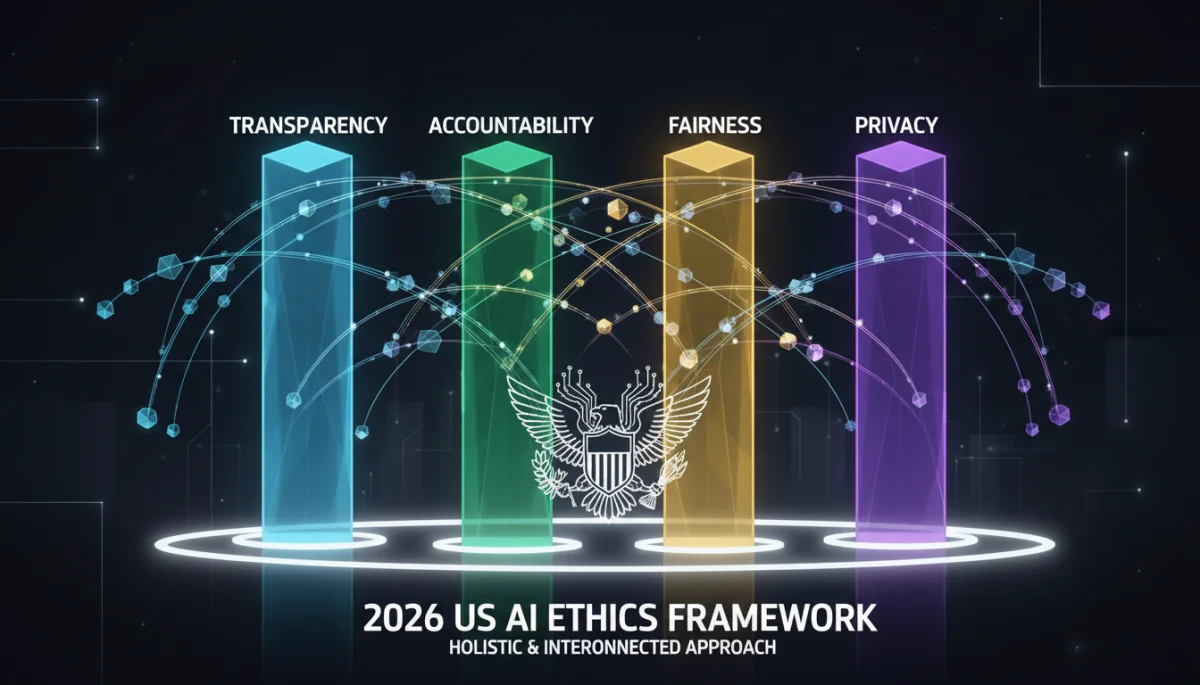
Another critical principle is fairness and non-discrimination. AI systems must be developed and used in a way that avoids creating or reinforcing unfair biases, ensuring equitable treatment for all individuals. This involves rigorous testing for algorithmic bias and implementing mechanisms to correct any identified disparities. Accountability is also paramount, establishing clear lines of responsibility for AI system outcomes and providing avenues for redress. These principles collectively form a robust ethical foundation for AI development in the US.
Addressing bias and fairness in AI systems
Bias and fairness stand as critical challenges in the ethical development of AI. The 2026 US AI ethics framework places significant emphasis on identifying, mitigating, and preventing algorithmic biases that can lead to discriminatory outcomes. This section explores the framework’s approach to ensuring fairness across all stages of the AI lifecycle, from data collection to deployment.
Algorithmic bias often arises from biased training data, which can reflect historical or societal prejudices. When AI systems are trained on such data, they can learn and perpetuate these biases, leading to unfair decisions in areas like hiring, lending, and criminal justice. The framework acknowledges that addressing these issues requires a multi-faceted strategy.

Strategies for bias detection and mitigation
The framework proposes several strategies to combat bias effectively. These include comprehensive data auditing, diverse dataset creation, and the implementation of fairness metrics during model development.
- Data Auditing: Regular and thorough examination of training datasets to identify and remove or rebalance biased samples.
- Fairness Metrics: Utilizing statistical measures to quantify and monitor fairness across different demographic groups, ensuring equitable performance.
- Algorithmic Design: Developing AI models with built-in mechanisms to reduce bias, such as adversarial debiasing techniques.
Furthermore, the framework advocates for diverse teams in AI development, recognizing that varied perspectives are crucial for identifying potential biases that might otherwise be overlooked. Human oversight and review processes are also essential, providing a crucial check against purely algorithmic decisions. This holistic approach aims to embed fairness into the very fabric of AI development, rather than treating it as an afterthought.
Ultimately, ensuring fairness in AI systems is not just an ethical imperative but also a practical necessity for building public trust and widespread adoption. The 2026 framework provides a clear roadmap for developers and organizations to proactively address bias, fostering AI technologies that serve all members of society equitably and without prejudice.
Accountability and governance in AI development
Establishing clear lines of accountability and robust governance structures is a cornerstone of the 2026 US AI ethics framework. As AI systems become more autonomous and their decisions more impactful, determining who is responsible for their actions and outcomes is paramount. This section explores how the framework addresses accountability and outlines the governance mechanisms designed to ensure responsible AI development and deployment.
The challenge of accountability in AI is complex, often involving multiple stakeholders from developers and deployers to users and regulators. The framework seeks to clarify these roles and responsibilities, moving beyond a purely technical perspective to encompass legal, ethical, and societal considerations. It emphasizes that accountability must be embedded throughout the entire AI lifecycle, not just at the point of deployment.
Mechanisms for oversight and redress
To ensure accountability, the framework proposes several key mechanisms. These include mandatory impact assessments, independent auditing, and clear channels for redress when AI systems cause harm.
- AI Impact Assessments: Requiring organizations to conduct thorough assessments of potential societal, ethical, and legal impacts before deploying AI systems.
- Independent Audits: Encouraging or mandating third-party audits of AI systems to verify compliance with ethical principles and identify vulnerabilities.
- Redress Mechanisms: Establishing clear and accessible processes for individuals to challenge AI-driven decisions and seek remedies for adverse outcomes.
The framework also advocates for the creation of dedicated AI ethics boards or committees within organizations, tasked with overseeing ethical compliance and fostering a culture of responsible innovation. These internal governance structures complement external regulatory oversight, creating a multi-layered system of checks and balances. The goal is to ensure that AI development is not only technologically sound but also ethically robust and socially responsible.
In conclusion, the 2026 US AI ethics framework recognizes that effective accountability and governance are essential for building trust in AI. By defining clear responsibilities, establishing oversight mechanisms, and providing avenues for redress, the framework aims to create an environment where AI systems can be developed and deployed with confidence, knowing that ethical considerations are at the forefront.
Privacy and data protection in the AI era
The intersection of artificial intelligence and personal data presents significant challenges for privacy and data protection. The 2026 US AI ethics framework places a strong emphasis on safeguarding individual privacy rights while enabling the innovative potential of AI. This section examines how the framework addresses these concerns, outlining principles and practices for responsible data handling in the AI era.
AI systems often rely on vast amounts of data to learn and make predictions. This reliance raises critical questions about data collection, storage, processing, and use, particularly when sensitive personal information is involved. The framework acknowledges that traditional privacy regulations may not be sufficient for the complexities introduced by AI, necessitating a tailored approach.
Privacy-enhancing technologies and practices
The framework promotes the adoption of privacy-enhancing technologies (PETs) and best practices to minimize data exposure and protect individual identities. These approaches aim to strike a balance between data utility and privacy protection.
- Differential Privacy: Techniques that add noise to data to obscure individual records while still allowing for aggregate analysis.
- Homomorphic Encryption: Methods that enable computations on encrypted data, preventing sensitive information from being exposed during processing.
- Federated Learning: A decentralized approach where AI models are trained on local datasets without centralizing raw data, enhancing privacy.
Beyond technological solutions, the framework also stresses the importance of data minimization, collecting only the data absolutely necessary for a specific purpose, and purpose limitation, ensuring data is used only for its intended and consented purpose. Transparent data governance policies and robust security measures are also critical components, building trust by demonstrating a commitment to protecting personal information.
In summary, the 2026 US AI ethics framework recognizes that robust privacy and data protection are non-negotiable in the AI era. By advocating for PETs, promoting data minimization, and establishing clear governance, the framework aims to empower individuals with greater control over their data while fostering responsible AI innovation that respects fundamental privacy rights.
Implementing the 2026 framework: challenges and opportunities
The implementation of the 2026 US AI ethics framework presents both significant challenges and exciting opportunities for organizations, policymakers, and the public. Translating ethical principles into practical guidelines and enforceable regulations requires careful consideration and collaborative effort. This section delves into the complexities of putting the framework into action and highlights the potential benefits of successful adoption.
One of the primary challenges lies in the dynamic nature of AI technology. As AI capabilities evolve rapidly, the framework must remain adaptable and future-proof, capable of addressing unforeseen ethical dilemmas. This necessitates a continuous review and update mechanism to ensure its relevance and effectiveness over time. Furthermore, achieving broad adoption across diverse industries, each with unique AI applications, requires tailored guidance and support.
Overcoming implementation hurdles
Several hurdles must be overcome to ensure successful implementation. These include fostering a culture of ethical AI, providing clear guidance for compliance, and addressing the technical complexities of integrating ethical considerations into AI development workflows.
- Education and Training: Developing comprehensive training programs for AI developers, ethicists, and policymakers to understand and apply the framework’s principles.
- Standardization: Creating industry-specific standards and best practices that align with the framework, making compliance more straightforward for organizations.
- Tooling and Infrastructure: Investing in tools and infrastructure that support ethical AI development, such as bias detection software and explainability platforms.
Despite these challenges, the opportunities presented by the 2026 framework are substantial. Successful implementation can lead to increased public trust in AI technologies, fostering innovation that is both powerful and responsible. It can also drive competitive advantages for US companies by positioning them as leaders in ethical AI, attracting talent and investment. Moreover, a robust ethical framework can help prevent costly legal and reputational damages associated with unethical AI practices.
In conclusion, the 2026 US AI ethics framework represents a forward-thinking approach to responsible AI. While its implementation will require concerted effort and ongoing adaptation, the long-term benefits of fostering trustworthy, fair, and transparent AI systems far outweigh the difficulties. It paves the way for a future where AI serves humanity’s best interests.
The future of AI ethics beyond 2026
While the 2026 US AI ethics framework provides a critical foundation, the journey of ethical AI development is continuous. The rapid pace of technological innovation ensures that new ethical challenges will emerge, necessitating ongoing adaptation and foresight. This section explores the trajectory of AI ethics beyond 2026, considering future trends and the need for evolving regulatory landscapes.
The framework is not a static document but a living guideline designed to evolve with AI itself. Future advancements, such as more sophisticated general AI or brain-computer interfaces, will introduce entirely new dimensions to ethical considerations. Therefore, the ability to anticipate and proactively address these future challenges will be paramount for maintaining responsible development.
Anticipating emerging ethical dilemmas
Looking beyond 2026, several key areas are likely to gain increased prominence in the AI ethics discourse. These include the ethical implications of autonomous decision-making in highly sensitive contexts, the societal impact of widespread AI-driven automation, and the global harmonization of AI ethics standards.
- Autonomous Weapons Systems: The ethical debate surrounding lethal autonomous weapons and the role of human control will intensify.
- AI and Human Cognition: As AI interfaces with human thought, questions of personal autonomy, identity, and consciousness will become central.
- Global Cooperation: The need for international collaboration on AI ethics will grow, aiming to establish common principles and prevent ethical arbitrage.
The framework’s success in the long term will depend on its capacity to foster continuous dialogue among stakeholders, including researchers, industry leaders, policymakers, and civil society. This collaborative approach will be essential for identifying emerging risks, developing innovative solutions, and ensuring that ethical considerations remain at the forefront of AI development. Furthermore, public engagement and education will play a crucial role in shaping a collective understanding of AI’s societal implications.
In conclusion, the 2026 US AI ethics framework serves as an important milestone, but it is just one step in an ongoing process. The future of AI ethics will demand constant vigilance, proactive adaptation, and a commitment to human-centric principles. By embracing this continuous evolution, we can ensure that AI remains a force for good, responsibly shaping the future for generations to come.
| Key Principle | Brief Description |
|---|---|
| Transparency | AI systems must be understandable and auditable, with clear documentation of processes. |
| Fairness | AI must avoid creating or reinforcing biases, ensuring equitable treatment for all. |
| Accountability | Clear responsibility for AI outcomes, with mechanisms for oversight and redress. |
| Privacy | Safeguarding personal data through minimization, encryption, and secure practices. |
Frequently asked questions about AI ethics in the US
The primary goal is to guide the responsible development and deployment of artificial intelligence in the United States. It aims to ensure AI systems are beneficial, fair, transparent, and accountable, fostering public trust and mitigating potential harms while promoting innovation across various sectors.
The framework addresses algorithmic bias through strategies like comprehensive data auditing, creating diverse datasets, implementing fairness metrics during model development, and promoting human oversight. It emphasizes a multi-faceted approach to identify, mitigate, and prevent biases from data collection to deployment.
Transparency is a cornerstone principle, requiring AI systems to be understandable and auditable. This includes clear documentation of data sources, model design, and decision-making processes. It aims to build trust by allowing users to comprehend how AI decisions are made and their potential impacts.
Yes, the framework establishes clear accountability mechanisms, including mandatory AI impact assessments, independent auditing, and accessible redress channels for individuals affected by AI decisions. It also encourages internal AI ethics boards to ensure oversight and foster responsible innovation within organizations.
The framework protects user privacy by promoting privacy-enhancing technologies (PETs) such as differential privacy and federated learning. It also advocates for data minimization, purpose limitation, transparent data governance, and robust security measures to safeguard personal information in AI systems.
Conclusion
The 2026 US AI ethics framework represents a crucial step towards fostering responsible and beneficial artificial intelligence. By emphasizing principles of transparency, fairness, accountability, and privacy, it provides a comprehensive roadmap for navigating the complex ethical landscape of AI development. While implementation will undoubtedly present challenges, the long-term benefits of building trustworthy AI systems for society are immense. This framework is not merely a set of regulations; it is a commitment to shaping a future where AI serves humanity’s best interests, ensuring that technological progress aligns with our deepest ethical values. As AI continues to evolve, so too must our ethical vigilance, making this framework a dynamic foundation for continuous adaptation and responsible innovation.
