AR/VR in Enterprise: 6 Practical Applications for US Training and Design in 2026
Anúncios
Augmented and virtual reality are poised to fundamentally reshape US enterprise training and design by 2026, offering unparalleled immersive experiences that drive significant improvements in efficiency, safety, and innovation.
The landscape of American enterprise is undergoing a profound transformation, driven by technological advancements that were once the stuff of science fiction. Among these, the integration of AR/VR in enterprise: 6 practical applications for US training and design in 2026 stands out as a game-changer. This immersive technology is no longer confined to gaming; it’s rapidly becoming an indispensable tool for businesses seeking to enhance operational efficiency, revolutionize employee training, and accelerate product development cycles.
Anúncios
Revolutionizing Employee Training and Onboarding
One of the most immediate and impactful applications of AR/VR in the enterprise sector is in transforming how companies train and onboard their employees. Traditional methods, often reliant on manuals, lectures, or shadowing, can be time-consuming and less effective. Immersive technologies offer a dynamic alternative, creating realistic simulations that prepare workers for real-world scenarios without risk.
Anúncios
Consider the benefits of virtual reality for complex machinery operation. Instead of learning on expensive, potentially dangerous equipment, new hires can practice in a VR environment, making mistakes and learning from them in a safe, controlled space. This not only reduces training costs but also significantly improves retention rates and accelerates skill acquisition.
Enhanced Skill Development
AR/VR platforms provide an unparalleled opportunity for employees to develop and refine critical skills. The ability to repeat tasks and receive instant feedback within a simulated environment fosters mastery.
- Procedural Training: Step-by-step guidance for complex operations, from surgical procedures to aircraft maintenance.
- Safety Drills: Realistic simulations of emergency situations, allowing employees to practice response protocols without actual danger.
- Soft Skills Training: Virtual role-playing scenarios to improve communication, leadership, and customer service skills.
These immersive experiences lead to more competent and confident employees, ready to tackle the challenges of their roles from day one. The spatial learning and immediate feedback loops inherent in AR/VR systems are far superior to passive learning methods, ensuring a deeper understanding and practical application of knowledge.
The conclusion for this section is clear: AR/VR is setting a new standard for corporate training, making it more effective, safer, and ultimately more cost-efficient for US enterprises. Its ability to create repeatable, measurable, and engaging learning experiences positions it as a cornerstone of future workforce development.
Accelerating Product Design and Prototyping
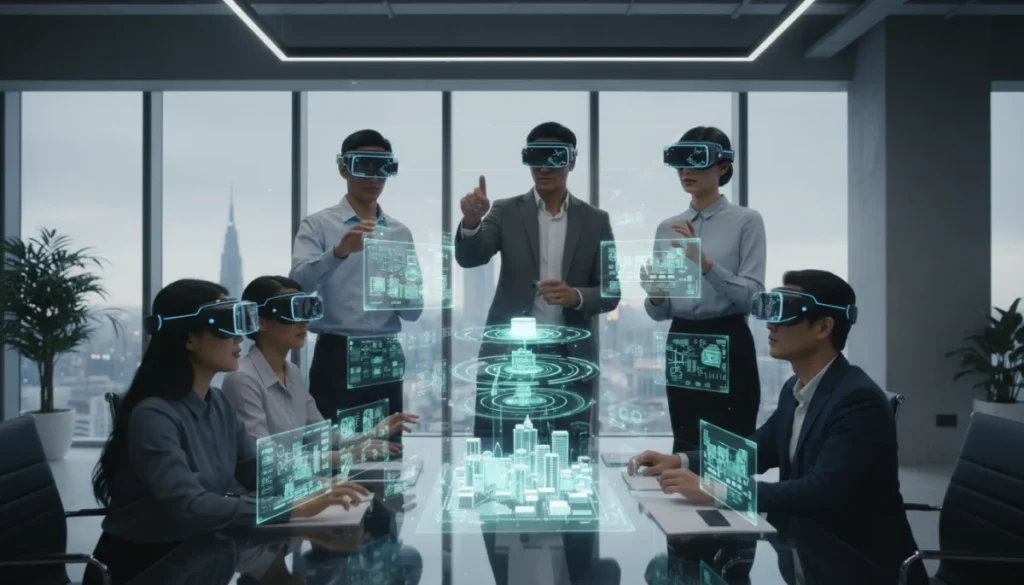
The design and manufacturing industries are experiencing a profound shift thanks to AR/VR. From automotive to architecture, these technologies are enabling faster iterations, better collaboration, and significantly reduced physical prototyping costs. Designers can now visualize and interact with 3D models in a fully immersive environment, identifying flaws and making adjustments long before physical production begins.
Imagine architects walking through a virtual building before it’s even broken ground, or engineers manipulating a complex engine design with their hands in a mixed reality space. This capability not only streamlines the design process but also enhances communication between stakeholders, ensuring everyone is on the same page regarding the final product.
Collaborative Design Spaces
AR/VR facilitates real-time collaboration among geographically dispersed design teams. Multiple users can enter the same virtual space, review designs, and make annotations simultaneously.
- Virtual Walkthroughs: Clients and designers can explore proposed designs of buildings, products, or spaces together.
- Real-time Feedback: Immediate visual and interactive feedback on design changes, accelerating decision-making.
- Cross-functional Review: Engineers, marketers, and sales teams can all provide input on a design from their unique perspectives.
This collaborative approach breaks down traditional barriers, fostering innovation and ensuring that products are developed with a holistic understanding of market needs and technical feasibility. The immersive nature of AR/VR allows for a level of detail and interaction that 2D screens simply cannot replicate, leading to more informed design choices.
In essence, AR/VR is transforming product design from a sequential, often costly process into a dynamic, collaborative, and highly efficient workflow. This translates into faster time-to-market and superior product quality for US companies.
Enhancing Maintenance and Field Service Operations
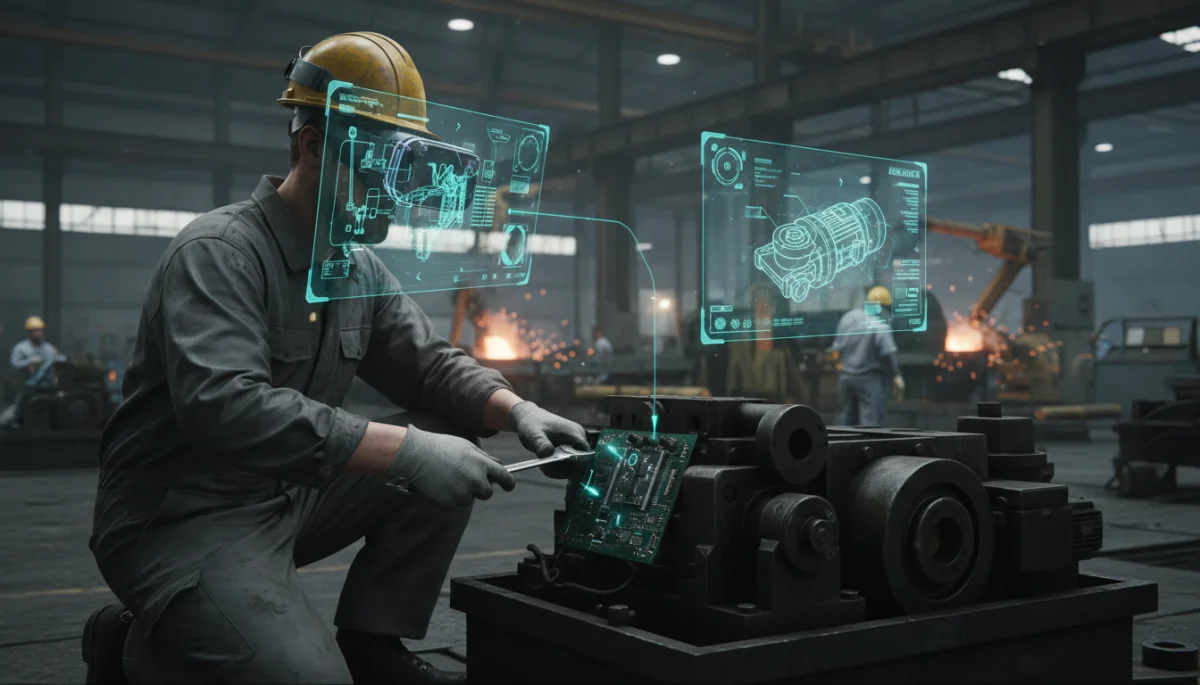
For industries reliant on complex machinery and extensive field operations, AR technology is proving invaluable. Technicians can wear AR glasses that overlay digital information onto their real-world view, providing step-by-step instructions, schematics, and even remote expert assistance. This significantly reduces downtime, improves first-time fix rates, and enhances safety.
Consider a scenario where a technician is repairing a specialized piece of equipment in a remote location. Instead of carrying bulky manuals or waiting for a senior expert to arrive, they can use AR to see virtual annotations guiding them through the repair process, or connect with an expert remotely who can draw directly into their field of view.
Remote Assistance and Troubleshooting
The ability to provide remote guidance through AR is a game-changer for field service and maintenance.
- Expert Overlay: Remote experts can draw, highlight, and annotate on a technician’s view in real-time.
- Digital Manuals: Access to comprehensive digital manuals and procedures directly within the field of view.
- Predictive Maintenance Integration: AR can display data from IoT sensors, alerting technicians to potential issues before they cause failures.
This not only empowers less experienced technicians but also maximizes the efficiency of highly specialized experts, allowing them to support multiple sites without travel. The reduction in travel time and associated costs, coupled with faster problem resolution, offers a significant competitive advantage.
Ultimately, AR is making maintenance and field service operations smarter, faster, and more efficient. US enterprises adopting these tools are seeing tangible benefits in operational continuity and cost savings.
Improving Sales and Marketing Experiences
Beyond internal operations, AR/VR is also reshaping how businesses engage with their customers, particularly in sales and marketing. Immersive experiences offer a novel way to showcase products and services, allowing potential buyers to interact with items virtually before making a purchase. This creates a more engaging and informative sales journey.
Think of furniture retailers allowing customers to place virtual furniture in their homes using AR, or real estate agents offering virtual tours of properties from anywhere in the world. These applications provide a level of immersion and personalization that traditional marketing simply cannot match, leading to higher engagement and conversion rates.
Interactive Product Visualization
AR/VR enables customers to visualize products in a highly interactive and realistic manner.
- Virtual Showrooms: Customers can explore entire product lines in a virtual environment.
- Product Customization: Users can customize products (e.g., car configurations, apparel designs) and see the changes instantly.
- Try-Before-You-Buy: AR apps allow users to virtually ‘try on’ clothes, glasses, or place items in their environment.
This direct interaction helps overcome common purchasing hurdles, building confidence and reducing the likelihood of returns. For complex B2B sales, VR can simulate the integration of new systems into a client’s existing infrastructure, providing a compelling demonstration of value.
The integration of AR/VR into sales and marketing strategies is creating more dynamic, personalized, and effective customer experiences, driving stronger connections and ultimately, increased revenue for US businesses.
Enhancing Healthcare Training and Patient Education
The healthcare sector is another area where AR/VR is making significant strides, particularly in medical training and patient education. Medical students and professionals can practice complex procedures in a risk-free virtual environment, improving proficiency and reducing errors. Patients, in turn, can gain a clearer understanding of their conditions and treatment plans through immersive visualizations.
Imagine surgeons rehearsing intricate operations multiple times in VR before entering the operating room, or medical students exploring human anatomy in 3D with unparalleled detail. This level of interactive learning far surpasses traditional cadaver labs or textbook studies.
Surgical and Procedural Simulation
VR offers highly realistic simulations for medical training, from basic procedures to advanced surgeries.
- Anatomical Exploration: Interactive 3D models of the human body for detailed study.
- Procedure Rehearsal: Surgeons can practice specific operations, refining motor skills and decision-making.
- Team Training: Medical teams can train together in simulated emergency scenarios.
For patient education, AR/VR can help explain complex diagnoses or treatment options in an understandable and engaging way, empowering patients to make more informed decisions about their health. This can lead to better adherence to treatment plans and improved health outcomes.
AR/VR is poised to elevate the standard of medical training and patient engagement in the US, contributing to a more skilled healthcare workforce and a more informed patient population.
Optimizing Logistics and Warehouse Operations
In the fast-paced world of supply chain and logistics, efficiency is paramount. AR technology is being deployed to optimize warehouse operations, from inventory management to order fulfillment. Workers equipped with AR devices can receive visual cues and instructions directly in their field of view, streamlining tasks and reducing errors.
Picture warehouse associates being guided to the exact location of an item for picking, with the AR system highlighting the correct product and quantity. This hands-free navigation and information access can dramatically increase picking accuracy and speed, especially in large and complex warehouses.
Smart Inventory Management
AR solutions enhance the accuracy and speed of inventory-related tasks.
- Guided Picking: Visual overlays direct workers to specific items and optimize picking routes.
- Inventory Audits: Faster and more accurate stock checks by scanning items with AR-enabled devices.
- Loading Optimization: AR can guide workers on how to best load trucks or containers for maximum space utilization.
By integrating AR with existing warehouse management systems, companies can achieve real-time visibility into their inventory and operations, leading to better decision-making and significant cost savings. The reduction in manual errors and the increase in operational speed provide a clear competitive edge.
Ultimately, AR/VR is making logistics and warehouse operations more intelligent, precise, and efficient, ensuring that US enterprises can meet the growing demands of modern supply chains.
| Key Application | Benefit for US Enterprise |
|---|---|
| Employee Training | Risk-free skill development, reduced costs, higher retention. |
| Product Design | Faster iterations, better collaboration, lower prototyping costs. |
| Field Service | Remote expert assistance, reduced downtime, improved accuracy. |
| Sales & Marketing | Engaging product visualization, personalized customer experiences. |
Frequently Asked Questions About AR/VR in Enterprise
The primary benefit is the creation of immersive, risk-free training environments. Employees can practice complex tasks and scenarios repeatedly, leading to faster skill acquisition, higher knowledge retention, and reduced training costs compared to traditional methods.
AR/VR significantly accelerates product design cycles by enabling interactive 3D visualization and real-time collaboration. Designers can identify and rectify flaws virtually, reducing the need for expensive physical prototypes and speeding up time-to-market.
Yes, AR dramatically improves field service efficiency by providing technicians with on-demand visual instructions, schematics, and remote expert assistance. This reduces repair times, minimizes errors, and enhances safety during complex maintenance tasks.
In sales and marketing, AR/VR creates engaging customer experiences through interactive product visualization and virtual showrooms. Customers can virtually ‘try on’ products or explore spaces, leading to increased engagement, better purchase decisions, and higher conversion rates.
Yes, AR/VR adoption is rapidly expanding across US enterprises, driven by demonstrated ROI in training, design, operations, and customer engagement. Businesses are increasingly recognizing its potential to deliver competitive advantages and drive innovation.
Conclusion
The integration of AR/VR into US enterprise operations is not merely a futuristic vision but a tangible reality rapidly taking shape. By 2026, these immersive technologies will be fundamental to how businesses train their workforce, design their products, manage their operations, and engage with their customers. The six practical applications discussed – from enhancing employee training and accelerating product design to optimizing field service and revolutionizing sales – underscore the profound impact AR/VR is having across diverse industries. As companies continue to seek innovative ways to boost efficiency, improve safety, and foster unprecedented levels of collaboration, AR/VR stands ready to deliver transformative solutions, solidifying its role as an indispensable tool for the modern enterprise.
