Cloud Migration for Business Growth: Reduce IT Costs 30% by 2027
Anúncios
Cloud migration for business growth: A 4-phase plan to reduce IT infrastructure costs by 30% by 2027 offers a strategic roadmap for enterprises to enhance operational efficiency and achieve significant financial savings.
In today’s rapidly evolving digital landscape, businesses are constantly seeking innovative ways to optimize operations, enhance agility, and reduce expenditures. One of the most impactful strategies gaining traction is cloud migration for business growth: A 4-phase plan to reduce IT infrastructure costs by 30% by 2027. This strategic shift from on-premise infrastructure to cloud-based solutions is not merely a technological upgrade; it’s a fundamental transformation that can unlock unprecedented opportunities for efficiency and financial savings. By carefully planning and executing a structured migration, organizations can not only modernize their IT but also position themselves for sustainable growth in a competitive market.
Anúncios
Understanding the imperative for cloud migration
The decision to embark on cloud migration is often driven by a confluence of factors, ranging from the need for enhanced scalability and flexibility to the desire for significant cost reductions. Traditional IT infrastructures are increasingly proving to be bottlenecks, struggling to keep pace with dynamic business demands and incurring substantial operational overheads. The imperative to move to the cloud stems from a recognition that agility and cost-efficiency are no longer optional but essential for survival and growth.
Many businesses find themselves grappling with outdated hardware, complex maintenance schedules, and the constant pressure to upgrade. This not only drains financial resources but also diverts valuable human capital from strategic initiatives. Cloud computing offers a compelling alternative, providing a resilient, scalable, and often more secure environment that can adapt to changing business needs without the heavy upfront investment associated with on-premise solutions. The promise of reducing IT infrastructure costs by 30% by 2027 is a powerful motivator, pushing companies to re-evaluate their current IT strategies.
Anúncios
The economic drivers of cloud adoption
Beyond the technical advantages, the financial benefits are a primary catalyst for cloud migration. Moving to a pay-as-you-go model eliminates the need for large capital expenditures on hardware and software licenses. This allows businesses to convert CapEx to OpEx, freeing up capital that can be reinvested into core business activities or innovation. Furthermore, the economies of scale offered by cloud providers often translate into lower operational costs for storage, compute, and networking.
- Reduced hardware procurement and maintenance.
- Lower energy consumption and data center footprint.
- Access to advanced services without significant upfront investment.
- Optimized resource utilization and reduced waste.
In conclusion, understanding the imperative for cloud migration involves recognizing both the operational efficiencies and the profound economic advantages it brings. It’s about building a more resilient, cost-effective, and future-proof IT foundation for sustained business growth.
Phase 1: comprehensive assessment and strategy formulation
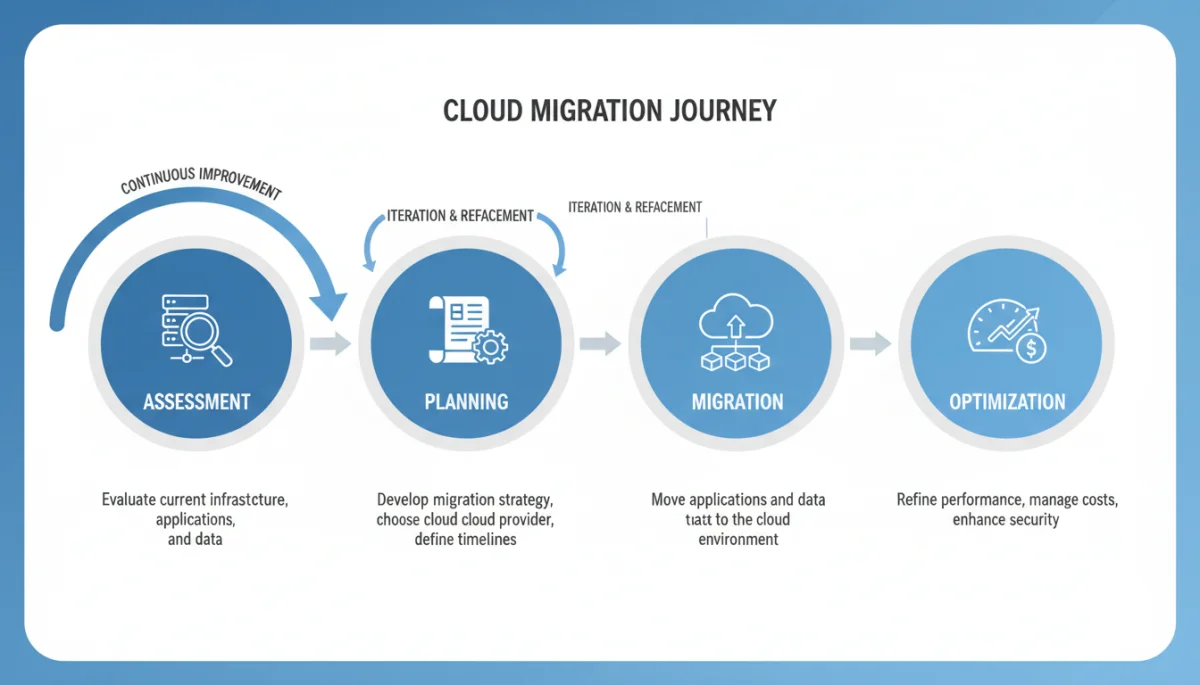
The initial and perhaps most critical phase of any successful cloud migration is a comprehensive assessment of the existing IT landscape and the formulation of a clear, actionable strategy. This phase lays the groundwork for the entire migration process, ensuring that objectives are well-defined, potential challenges are identified, and the chosen cloud strategy aligns perfectly with overarching business goals.
During this phase, organizations must meticulously analyze their current applications, data, and infrastructure. This involves understanding dependencies, performance requirements, security considerations, and compliance mandates. A thorough inventory helps in categorizing workloads and determining the most suitable migration approach for each, whether it’s re-hosting, re-platforming, refactoring, or even retiring certain applications.
Key activities in the assessment phase
A detailed assessment goes beyond just cataloging assets. It involves a deep dive into how each application contributes to business value, its current operational costs, and its potential benefits in a cloud environment. This information is crucial for building a compelling business case for migration and securing stakeholder buy-in.
- Application portfolio analysis: Identify and categorize all applications, their interdependencies, and criticality.
- Infrastructure audit: Document current hardware, software, networking, and security configurations.
- Cost analysis: Calculate total cost of ownership (TCO) for current on-premise infrastructure versus projected cloud costs.
- Risk assessment: Identify potential security, compliance, and operational risks associated with migration.
Formulating a strategy involves defining clear objectives, selecting the right cloud provider(s), and establishing a migration roadmap. This includes setting realistic timelines, allocating resources, and identifying key performance indicators (KPIs) to measure success. A well-defined strategy acts as a compass, guiding the entire migration journey towards the desired outcome of reduced IT costs and enhanced business capabilities.
Phase 2: meticulous planning and pilot execution
With a comprehensive assessment completed and a strategic roadmap in place, Phase 2 shifts focus to meticulous planning and the execution of pilot migrations. This phase is about translating the strategy into detailed action plans, ensuring that every aspect of the migration is carefully considered and prepared for. It’s also where initial, smaller-scale migrations are conducted to validate assumptions and refine processes.
Detailed planning involves designing the target cloud architecture, selecting appropriate cloud services, and defining migration methodologies for different types of workloads. This includes setting up networking, security groups, identity and access management (IAM), and monitoring tools within the chosen cloud environment. The goal is to create a robust and secure cloud foundation that can support future operations.
Designing the target cloud architecture
The target cloud architecture must be designed with scalability, resilience, and cost-efficiency in mind. This involves choosing the right compute, storage, database, and networking services that align with application requirements and performance expectations. Consideration must also be given to disaster recovery, backup strategies, and compliance with industry-specific regulations.
- Infrastructure as Code (IaC): Automate environment provisioning for consistency and speed.
- Network topology: Design secure and efficient connectivity between on-premise and cloud resources.
- Security controls: Implement robust security measures, including firewalls, encryption, and access policies.
- Monitoring and logging: Establish comprehensive monitoring to track performance and identify issues.
Pilot migrations are invaluable for gaining practical experience and identifying unforeseen challenges in a controlled environment. By starting with non-critical applications or datasets, organizations can test their migration tools, processes, and rollback strategies. The lessons learned from these pilots are then incorporated into the broader migration plan, significantly reducing risks for subsequent migrations.
Phase 3: streamlined migration and data transfer
Phase 3 is the core execution phase where applications and data are systematically moved to the cloud. This stage demands careful coordination, robust tools, and a clear understanding of potential downtime implications. The objective is to perform the migration efficiently, minimizing disruption to business operations while ensuring data integrity and security.
Depending on the chosen migration strategy (re-host, re-platform, refactor), the methods for moving applications and data will vary. For instance, re-hosting often involves ‘lift and shift’ tools that automate the transfer of virtual machines. Re-platforming might require some modifications to applications, while refactoring entails significant code changes to leverage native cloud services, offering greater long-term benefits but demanding more effort upfront.
Ensuring data integrity and security during transfer
Data is the lifeblood of any business, and its secure and accurate transfer is paramount. Organizations must employ robust data migration tools and strategies that include encryption in transit and at rest, data validation, and comprehensive backup procedures. Minimizing downtime is also a key consideration, often achieved through phased migrations, replication technologies, and careful scheduling of cutover events.
- Incremental data synchronization: Reduce cutover windows by continuously replicating data.
- Network bandwidth optimization: Ensure sufficient bandwidth for efficient data transfer.
- Automated migration tools: Leverage cloud provider services or third-party tools for efficiency.
- Pre- and post-migration testing: Validate application functionality and data accuracy.
Throughout this phase, continuous monitoring and communication are crucial. Teams must be prepared to address any issues that arise promptly and effectively. A successful streamlined migration not only moves workloads to the cloud but also sets the stage for optimizing these workloads for performance and cost.
Phase 4: optimization, governance, and continuous improvement
The migration to the cloud is not a one-time event; it’s the beginning of a continuous journey of optimization and improvement. Phase 4 focuses on ensuring that the migrated environment is performing optimally, costs are being managed effectively, and governance policies are in place to sustain the benefits. This is where the 30% IT infrastructure cost reduction by 2027 truly materializes and is maintained.
Optimization involves fine-tuning cloud resources to match actual demand, identifying opportunities for further cost savings, and enhancing performance. This can include right-sizing virtual machines, implementing auto-scaling, utilizing reserved instances, and leveraging serverless computing where appropriate. Continuous monitoring of resource utilization and expenditure is essential to identify areas for improvement.
Establishing robust cloud governance
Effective cloud governance is critical for controlling costs, ensuring security, and maintaining compliance in the long term. This involves defining policies for resource provisioning, access management, security configurations, and cost allocation. Without proper governance, cloud environments can quickly become sprawling and expensive, eroding the benefits of migration.
- Cost management tools: Utilize cloud provider tools to track, analyze, and optimize spending.
- Performance monitoring: Continuously monitor application and infrastructure performance to identify bottlenecks.
- Security posture management: Regularly review and update security configurations and policies.
- Automation of operations: Implement automation for routine tasks, patching, and deployments.
The journey to the cloud is iterative. Organizations should embrace a culture of continuous improvement, regularly reviewing their cloud strategy, adopting new services, and refining their operations to maximize value. This ongoing commitment to optimization and governance ensures that the initial goals of cost reduction and business growth are not only met but exceeded over time.
Measuring success: achieving the 30% cost reduction by 2027
A key aspect of any strategic initiative is the ability to measure its success against predefined objectives. For cloud migration, the ambitious goal of reducing IT infrastructure costs by 30% by 2027 requires clear metrics, consistent tracking, and a commitment to data-driven decision-making. This section explores how organizations can effectively measure their progress and ensure they are on track to meet this significant financial target.
Measuring success goes beyond simply comparing pre- and post-migration invoices. It involves a holistic view of IT expenditure, including not only direct cloud service costs but also indirect savings from reduced operational overheads, increased team productivity, and avoided capital expenditures. Establishing a baseline of current IT costs before migration is crucial for accurate comparison.
Key performance indicators for cost reduction
To accurately track the 30% cost reduction target, businesses should define and monitor a set of relevant KPIs. These indicators provide tangible proof of savings and highlight areas where further optimization may be needed. Regular reporting and analysis of these metrics are essential for maintaining momentum and making informed adjustments to the cloud strategy.
- Total cost of ownership (TCO) reduction: Compare overall IT spending before and after migration.
- Unit cost reduction: Analyze the cost per user, per application, or per transaction.
- Operational efficiency gains: Measure time saved on IT administration and maintenance tasks.
- Capital expenditure avoidance: Quantify the reduction in hardware and software purchases.
Achieving a 30% cost reduction by 2027 is an ambitious but attainable goal through a well-executed cloud migration strategy. By continuously monitoring performance, optimizing resource utilization, and fostering a culture of financial accountability, businesses can realize significant and sustainable savings that directly contribute to their bottom line and fuel future growth.
Navigating common challenges in cloud migration
While the benefits of cloud migration are substantial, the journey is not without its challenges. Successfully navigating these hurdles is crucial for ensuring a smooth transition and realizing the promised cost reductions and business growth. Anticipating and preparing for common obstacles can significantly mitigate risks and keep the migration project on track.
One of the most frequently encountered challenges is managing complex interdependencies between applications and data. Many legacy systems are tightly coupled, making it difficult to move components independently. This requires meticulous planning and often a phased approach to migration, ensuring that critical connections are maintained or re-established correctly in the cloud environment.
Addressing security and compliance concerns
Security is often cited as a primary concern for organizations considering cloud migration. While cloud providers invest heavily in security infrastructure, businesses are still responsible for securing their data and applications within the cloud. This shared responsibility model requires a clear understanding of roles and robust implementation of security best practices.
- Data residency and sovereignty: Ensure data is stored and processed in compliance with local regulations.
- Identity and access management (IAM): Implement strong authentication and authorization controls.
- Compliance audits: Regularly audit cloud environments against industry standards and regulations.
- Vendor lock-in: Design architectures that allow for flexibility and avoid excessive reliance on a single provider.
Another significant challenge is managing organizational change. Cloud migration often requires new skills, processes, and a shift in mindset for IT teams. Investing in training and fostering a culture of continuous learning is essential for empowering employees to adapt to the new cloud-centric operational model. By proactively addressing these challenges, businesses can ensure a more successful and less disruptive cloud migration journey.
| Key Phase | Brief Description |
|---|---|
| Assessment & Strategy | Analyze current IT, define objectives, and choose cloud approach. |
| Planning & Pilots | Design cloud architecture, plan migration, and execute small-scale tests. |
| Migration & Data Transfer | Move applications and data, ensuring integrity and minimal downtime. |
| Optimization & Governance | Continuously fine-tune resources, manage costs, and ensure compliance. |
Frequently asked questions about cloud migration
The primary benefits include significant IT cost reduction, enhanced scalability and flexibility, improved operational efficiency, increased business agility, and better disaster recovery capabilities. Cloud migration allows businesses to adapt faster to market changes and innovate more rapidly.
Achieving a 30% cost reduction by 2027 requires a strategic 4-phase plan: comprehensive assessment, meticulous planning, streamlined migration, and continuous optimization with robust governance. Key is consistent monitoring and right-sizing resources post-migration.
Pilot migrations are crucial for testing assumptions, validating chosen tools and processes, and identifying potential challenges in a controlled environment. They provide valuable lessons learned that can be applied to larger-scale migrations, significantly reducing risks and improving efficiency.
Common challenges include managing application interdependencies, ensuring data security and compliance, addressing potential vendor lock-in, and navigating organizational change. Proactive planning, robust security measures, and employee training are vital for success.
Continuous optimization ensures that cloud resources are always aligned with business needs, preventing cost overruns and maximizing performance. It involves regular monitoring, right-sizing, automation, and adapting to new cloud services to maintain cost efficiency and agility.
Conclusion
Embracing cloud migration for business growth: A 4-phase plan to reduce IT infrastructure costs by 30% by 2027 is no longer a futuristic concept but a present-day necessity for businesses aiming for sustained success. The journey, while complex, offers a clear path to significant financial savings, enhanced operational flexibility, and a stronger competitive edge. By meticulously following the outlined phases—assessment, planning, migration, and continuous optimization—organizations can effectively modernize their IT landscape, unlock new capabilities, and secure a more agile and cost-efficient future. The commitment to this transformation will not only reduce IT expenditures but also empower businesses to innovate faster and respond more effectively to the dynamic demands of the digital economy.
