Save 20% on Cloud Costs: FinOps for AI Workloads in 2026
Anúncios
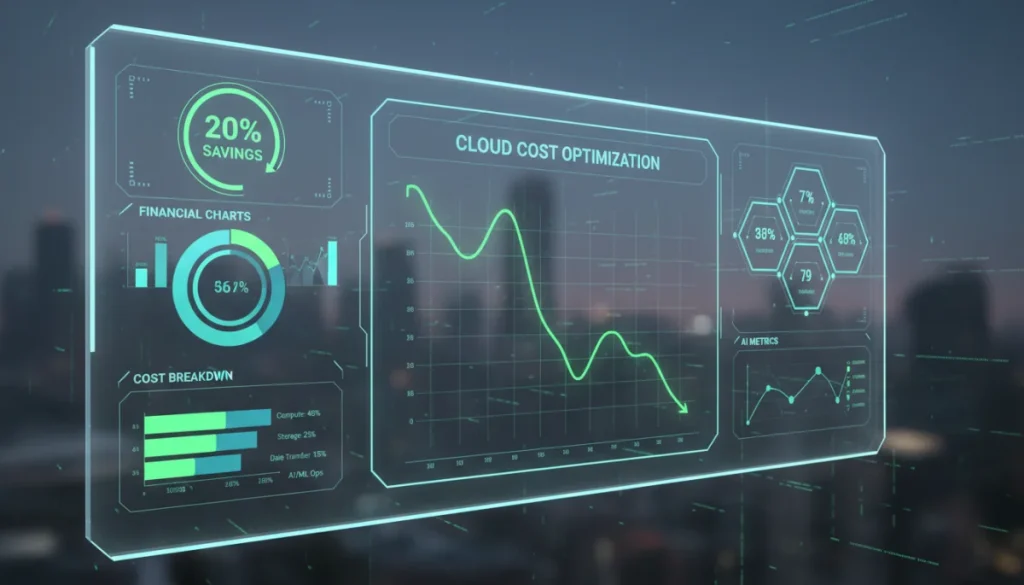
Implementing FinOps strategies for AI workloads in 2026 is crucial for organizations aiming to achieve significant financial savings, potentially reducing cloud costs by 20% through optimized resource utilization, transparent spending, and enhanced financial accountability.
Anúncios
Are you ready to discover how saving 20% on cloud costs: implementing FinOps strategies for AI workloads in 2026 (financial impact) can fundamentally reshape your organization’s financial landscape? As AI adoption accelerates, managing its associated cloud expenditures becomes paramount for sustainable growth and innovation.
Understanding the FinOps imperative for AI workloads
The rapid expansion of Artificial Intelligence (AI) workloads in the cloud has brought unprecedented innovation and capability, but it has also introduced a complex challenge: managing escalating cloud costs. FinOps, a cultural practice that brings financial accountability to the variable spend model of cloud, is emerging as the critical solution. It’s not just about cutting costs; it’s about maximizing business value from every dollar spent on cloud resources, especially for demanding AI applications.
Anúncios
AI workloads, by their nature, are resource-intensive. They require significant computational power, vast storage, and often specialized hardware like GPUs. Without proper governance, these resources can quickly lead to budget overruns. FinOps provides the framework to gain visibility, optimize, and forecast these expenditures effectively.
The convergence of AI and cloud economics
The synergy between AI and cloud computing is undeniable, yet it often creates a paradox: immense innovation alongside potential financial drain. Cloud providers offer elastic and scalable infrastructure, perfectly suited for the dynamic needs of AI model training and inference. However, this elasticity also means that costs can fluctuate wildly if not carefully managed.
- Dynamic resource allocation for AI.
- Complex pricing models across providers.
- High demand for specialized hardware.
- Lack of cost visibility for specific AI projects.
Why FinOps is non-negotiable for AI in 2026
By 2026, AI is expected to be deeply embedded in enterprise operations, making efficient cloud spending a strategic imperative. FinOps ensures that engineering, finance, and business teams collaborate to make data-driven decisions about cloud usage. This collaborative approach fosters a culture of cost-awareness without hindering innovation.
Ultimately, understanding the FinOps imperative for AI workloads means recognizing that financial discipline is an enabler, not a limiter, of technological advancement. It positions organizations to leverage AI’s full potential while maintaining fiscal responsibility.
Key principles of FinOps for AI cost optimization
Implementing FinOps effectively for AI workloads hinges on adopting its core principles, which foster collaboration, transparency, and continuous optimization. These principles move beyond traditional cost management by embedding financial accountability into every stage of the cloud lifecycle. For AI, where resource consumption can be highly variable and unpredictable, these principles are particularly vital for achieving significant savings.
Visibility: knowing where every dollar goes
The first step in any FinOps journey is achieving comprehensive visibility into cloud spending. For AI workloads, this means granular insights into the costs associated with specific models, training runs, data storage, and compute instances. Without this clarity, identifying areas for optimization is nearly impossible.
- Detailed cost allocation tags for AI projects.
- Real-time dashboards showing AI resource consumption.
- Attribution of costs to specific teams or business units.
Optimization: maximizing value, minimizing waste
Once spending is visible, the focus shifts to optimization. This involves right-sizing resources, leveraging discounts, and automating cost-saving measures. For AI, this could mean optimizing model training schedules, choosing the most cost-effective GPU instances, or implementing serverless functions for inference where appropriate.
Continuous optimization is not a one-time event but an ongoing process of refinement and adjustment. It requires constant monitoring and adaptation to evolving AI needs and cloud provider offerings.
Collaboration: breaking down silos
FinOps thrives on collaboration between engineering, finance, and business teams. Engineers understand the technical requirements of AI workloads, finance professionals provide budget oversight, and business stakeholders define the value proposition. When these teams work together, they can make informed decisions that balance performance, cost, and business objectives.
By adhering to these key FinOps principles, organizations can create a robust framework for managing AI cloud costs, paving the way for sustainable innovation and significant financial impact.
Strategies for achieving 20% cloud cost savings in AI
Achieving a 20% reduction in cloud costs for AI workloads by 2026 is an ambitious yet attainable goal through a combination of strategic FinOps practices and technological leverage. This requires a proactive approach, moving beyond reactive cost cutting to embedding cost awareness into the entire AI development lifecycle. The focus should be on intelligent resource management and continuous improvement.
Right-sizing and resource utilization
One of the most immediate and impactful strategies is ensuring that AI workloads are running on appropriately sized instances. Over-provisioning compute or storage resources for AI model training or inference leads directly to wasted expenditure. Tools for monitoring resource utilization are critical here.
- Automated instance resizing based on workload demand.
- Identifying and terminating idle AI development environments.
- Leveraging serverless computing for sporadic AI tasks.
Leveraging cloud provider discounts and commitments
Cloud providers offer various pricing models designed to reward commitment. Reserved Instances (RIs) and Savings Plans can offer substantial discounts for predictable AI workloads, especially for long-running training jobs or persistent inference services. Strategic planning is essential to maximize these benefits without over-committing.
Furthermore, exploring spot instances for fault-tolerant AI tasks, such as hyperparameter tuning or large-scale data processing, can significantly reduce costs. This requires a robust architecture capable of handling potential interruptions.
Cost governance and automation
Implementing strong cost governance policies and automating cost-saving actions are foundational for sustained savings. This includes setting budget alerts, enforcing tagging policies for cost allocation, and automating the shutdown of non-production environments during off-hours. Automation reduces human error and ensures consistent application of FinOps best practices.
By systematically applying these strategies, organizations can realistically aim for and achieve substantial reductions in their AI cloud spending, freeing up capital for further innovation and strategic investments.
Tools and technologies supporting FinOps for AI
The successful implementation of FinOps strategies for AI workloads relies heavily on the right set of tools and technologies. These solutions provide the necessary visibility, automation, and analytical capabilities to manage complex cloud environments effectively. From native cloud provider offerings to third-party platforms, a robust toolkit is essential for making data-driven decisions and realizing significant cost efficiencies.
Native cloud provider cost management tools
Major cloud providers like AWS, Azure, and Google Cloud offer their own suite of cost management tools. These include dashboards for tracking spending, budget alerts, cost explorers for detailed analysis, and recommendations for optimization. They are foundational for understanding basic cloud expenditures and identifying quick wins.
For AI-specific services, these tools can often break down costs by service, region, and even specific AI projects if proper tagging is implemented. Leveraging these native capabilities is the first step towards a comprehensive FinOps practice.
Third-party FinOps platforms and solutions
Beyond native tools, a growing ecosystem of third-party FinOps platforms provides enhanced capabilities, especially for multi-cloud environments or organizations with highly complex AI infrastructures. These platforms often offer advanced analytics, anomaly detection, automated optimization suggestions, and more sophisticated reporting.
- Unified cost visibility across multiple cloud providers.
- AI-driven recommendations for resource optimization.
- Automated enforcement of cost policies.
- Integration with existing financial and operational systems.
AI-powered cost optimization for AI itself
Ironically, AI can also be leveraged to optimize the costs of AI workloads. Machine learning algorithms can analyze historical usage patterns and predict future resource needs, leading to more accurate provisioning. They can also identify inefficiencies in real-time, such as underutilized GPUs or inefficient data pipelines, and suggest corrective actions.
The right combination of these tools and technologies forms the backbone of an effective FinOps strategy, empowering organizations to gain control over their AI cloud spending and drive financial efficiency.
Building a FinOps culture within AI teams
Beyond tools and processes, the true success of FinOps in managing AI cloud costs lies in cultivating a strong FinOps culture within development, data science, and engineering teams. This cultural shift transforms how teams perceive and interact with cloud resources, embedding cost-consciousness into every decision. It moves from a mindset where developers simply consume resources to one where they are empowered to be responsible stewards of cloud spend.
Education and awareness programs
Initiating comprehensive education and awareness programs is paramount. Many technical professionals may not fully grasp the financial implications of their cloud resource choices. Training should cover cloud pricing models, the impact of different instance types on cost, and best practices for resource provisioning and de-provisioning for AI workloads.
Regular workshops and easily accessible documentation can help demystify cloud billing and highlight the direct connection between technical decisions and financial outcomes. This fosters a sense of ownership over cloud spend.
Shared responsibility and collaboration
FinOps thrives on shared responsibility. This means breaking down traditional silos between finance, operations, and AI development teams. Establishing clear lines of communication and encouraging cross-functional collaboration ensures that everyone is working towards the common goal of optimizing cloud value. Finance provides cost data, operations provides infrastructure insights, and AI teams provide workload requirements.

Incentivizing cost-efficient behavior
To truly embed FinOps, organizations should consider incentivizing cost-efficient behaviors. This doesn’t mean penalizing resource usage but rather rewarding teams for innovative solutions that reduce waste without compromising performance or project timelines. Gamification, recognition programs, or tying cost efficiency to performance reviews can be effective.
By building a FinOps culture, AI teams become active participants in managing cloud costs, leading to more sustainable and financially responsible AI innovation. This cultural shift is arguably the most powerful lever for sustained cost savings.
Measuring and reporting financial impact
The ultimate goal of implementing FinOps strategies for AI workloads is to demonstrate a tangible financial impact. This requires robust mechanisms for measuring, tracking, and reporting cost savings and efficiencies. Without clear metrics and regular reporting, it’s difficult to justify the investment in FinOps and to identify areas for further improvement. Transparency in financial reporting is a cornerstone of FinOps.
Key performance indicators (KPIs) for FinOps
Defining relevant KPIs is crucial for evaluating FinOps success. These KPIs should go beyond simple cost reduction to encompass efficiency, utilization, and business value. For AI workloads, specific metrics might include cost per model trained, cost per inference, or resource utilization rates for GPU instances.
- Cloud spend per AI project or business unit.
- Percentage of reserved instances/savings plans utilized.
- Resource utilization rates for compute and storage.
- Cost avoidance from optimized resource provisioning.
Regular reporting and review cycles
Establishing regular reporting and review cycles ensures that stakeholders are continuously informed about cloud spending and optimization efforts. These reports should be tailored to different audiences: detailed technical reports for engineering teams and high-level summaries with financial impact statements for leadership. Monthly or quarterly reviews facilitate discussions and adjustments to strategy.
The reporting should highlight not just savings, but also the value generated by cloud spend, demonstrating that investments in AI are yielding positive returns. This holistic view reinforces the business case for FinOps.
Attributing savings to FinOps initiatives
It’s important to clearly attribute achieved savings to specific FinOps initiatives. This involves tracking the before-and-after costs of implementing a new optimization strategy, such as right-sizing instances or purchasing a new Savings Plan. Quantifying the impact validates FinOps efforts and builds momentum for continued investment.
By diligently measuring and reporting the financial impact, organizations can clearly demonstrate the value of FinOps in saving 20% on cloud costs for AI workloads, reinforcing its strategic importance for 2026 and beyond.
The future of FinOps and AI in 2026 and beyond
As we look towards 2026 and beyond, the intersection of FinOps and Artificial Intelligence is set to become even more intertwined and critical. The evolving landscape of cloud computing, coupled with the increasing sophistication and scale of AI deployments, will necessitate more advanced and integrated FinOps practices. This future will be characterized by greater automation, predictive capabilities, and a deeper integration into overall business strategy.
Predictive cost management with AI
One of the most exciting developments will be the use of AI itself to predict and manage cloud costs. Machine learning models will analyze historical spending patterns, project future resource needs based on AI workload growth, and even recommend optimal pricing strategies in real-time. This moves FinOps from a reactive to a proactive discipline, anticipating costs before they accrue.
Predictive analytics will enable more precise budgeting, smarter capacity planning for AI infrastructure, and better utilization of committed spend options like Reserved Instances or Savings Plans. This significantly enhances the ability to achieve and sustain cost savings.
Enhanced automation of cost optimization
The future will see a significant increase in the automation of cost optimization tasks. Instead of manual adjustments, AI-powered systems will automatically right-size instances, adjust scaling policies, and even identify and terminate idle resources without human intervention. This level of automation will free up engineering teams to focus on innovation rather than manual cost control.
- Automated policy enforcement for resource tagging.
- Real-time adjustment of cloud resources based on demand.
- Self-optimizing AI model training pipelines.
FinOps as a strategic business enabler
By 2026, FinOps will no longer be viewed merely as a cost-cutting measure but as a strategic business enabler. It will be deeply integrated into the decision-making processes for new AI projects, influencing architecture design, technology choices, and deployment strategies from inception. This ensures that financial considerations are baked into AI initiatives from day one, maximizing return on investment.
The future of FinOps and AI is one of symbiotic growth, where financial discipline fuels technological advancement, allowing organizations to innovate more rapidly and sustainably in the cloud.
| Key FinOps Principle | Impact on AI Cloud Costs |
|---|---|
| Visibility | Enables precise tracking of AI resource spending. |
| Optimization | Reduces waste through right-sizing and discounts. |
| Collaboration | Fosters shared responsibility for cost-efficient AI. |
| Automation | Streamlines cost-saving actions and policy enforcement. |
Frequently Asked Questions about FinOps and AI Cloud Costs
FinOps for AI workloads is a cultural practice combining financial accountability with cloud spending for Artificial Intelligence. It enables organizations to manage and optimize their cloud costs effectively, ensuring that every dollar spent on AI resources delivers maximum business value and avoids unnecessary expenditure.
FinOps helps achieve significant savings by providing detailed cost visibility, enabling right-sizing of resources, leveraging cloud provider discounts like Reserved Instances, and fostering collaboration among teams. These practices collectively identify and eliminate waste, leading to substantial cost reductions, potentially up to 20% or more.
The key principles include visibility (understanding spending), optimization (maximizing value and minimizing waste), and collaboration (breaking down silos between finance, engineering, and business teams). These principles ensure a holistic approach to managing AI cloud costs, promoting shared responsibility and continuous improvement across the organization.
Essential tools include native cloud provider cost management dashboards (e.g., AWS Cost Explorer, Azure Cost Management), third-party FinOps platforms for multi-cloud environments, and AI-powered solutions for predictive cost management and automated optimization. These tools provide the necessary data and automation for effective cost control.
A FinOps culture is crucial because it embeds cost-consciousness into every decision made by AI teams. It encourages shared responsibility, educates on financial impacts, and incentivizes efficient behavior. This cultural shift ensures that financial discipline supports, rather than hinders, innovation and sustainable growth in AI development and deployment.
Conclusion
The journey towards saving 20% on cloud costs: implementing FinOps strategies for AI workloads in 2026 (financial impact) is not merely a technical endeavor but a strategic organizational imperative. By embracing the principles of visibility, optimization, and collaboration, and by leveraging the right tools and fostering a robust FinOps culture, businesses can transform their approach to cloud spending. This proactive management of AI cloud resources not only delivers significant financial savings but also empowers teams to innovate more sustainably and efficiently, securing a competitive edge in the rapidly evolving digital landscape. The future of AI in the cloud is undeniably linked to intelligent financial governance, making FinOps an indispensable practice for success.
