Blockchain Beyond Crypto: Revolutionizing US Supply Chains by 2026
Anúncios
Blockchain technology is poised to redefine US supply chains by 2026, moving far beyond its cryptocurrency origins to deliver unparalleled transparency, efficiency, and security in complex logistical operations.
The landscape of global commerce is undergoing a profound transformation, with technological advancements continually reshaping how goods move from origin to consumer. Among these, blockchain supply chain US applications are emerging as a pivotal force, promising to revolutionize the sector by 2026. This isn’t just about digital currencies; it’s about leveraging a distributed, immutable ledger to solve long-standing challenges in transparency, efficiency, and trust within complex logistical networks across the United States.
Anúncios
Enhanced Transparency and Traceability in Food Supply Chains
The journey of food from farm to fork is often opaque, making it challenging to identify contamination sources or verify ethical practices. Blockchain technology offers a solution by creating an unalterable record of every step a product takes, significantly enhancing consumer safety and brand integrity.
This increased visibility is particularly crucial in an era where consumers demand more information about what they eat and where it comes from. Recalls can be managed with unprecedented speed and precision, reducing waste and minimizing public health risks.
Anúncios
Real-time Tracking and Data Integrity
Blockchain’s distributed ledger ensures that once data is entered, it cannot be altered, providing a single source of truth for all participants. This means real-time tracking of produce, meat, and other perishables, from cultivation to retail shelves.
- Origin Verification: Consumers can scan a QR code to see the farm where their food was grown.
- Temperature Monitoring: Sensors can log temperature data onto the blockchain, ensuring product quality.
- Authenticity Assurance: Prevents food fraud and verifies organic or fair-trade claims.
- Rapid Recall Management: Pinpoints affected batches instantly, reducing market impact.
The ability to track every input, every process, and every transfer of ownership creates an auditable trail that benefits producers, distributors, retailers, and ultimately, the consumer. This level of granular detail was previously unimaginable and is setting new standards for food safety and accountability.
Streamlining Pharmaceutical Supply Chain Logistics
The pharmaceutical industry faces immense pressure to ensure drug authenticity, prevent counterfeiting, and manage complex distribution networks. Blockchain offers a robust framework to address these critical issues, protecting patient safety and securing high-value assets.
By providing an immutable record of a drug’s journey, from manufacturing to dispensing, blockchain can combat the pervasive problem of counterfeit medications, which pose significant health risks and economic losses globally.
Combating Counterfeiting and Ensuring Authenticity
Each unit of medication can be assigned a unique identifier, with its journey recorded on a blockchain. This creates a secure, verifiable history that makes it nearly impossible for counterfeit products to infiltrate the legitimate supply chain.
Pharmaceutical companies can use blockchain to track active pharmaceutical ingredients (APIs), monitor manufacturing processes, and verify the cold chain integrity for sensitive drugs. This comprehensive oversight builds trust across the entire ecosystem.
- Serialization: Unique identifiers for each drug package are recorded.
- Pedigree Tracking: Full history of ownership transfers is maintained.
- Temperature Control: Verifiable logs of storage conditions for temperature-sensitive drugs.
- Regulatory Compliance: Simplifies adherence to strict industry regulations like DSCSA.
The implications for patient safety are profound. Knowing that every medication is genuine and has been handled correctly provides peace of mind, while also significantly reducing the financial burden associated with counterfeit drug incidents and recalls.
Optimizing Manufacturing and Inventory Management
Modern manufacturing often involves intricate supply chains with multiple tiers of suppliers, making inventory management and production scheduling a constant challenge. Blockchain can bring unprecedented visibility and efficiency to these operations.
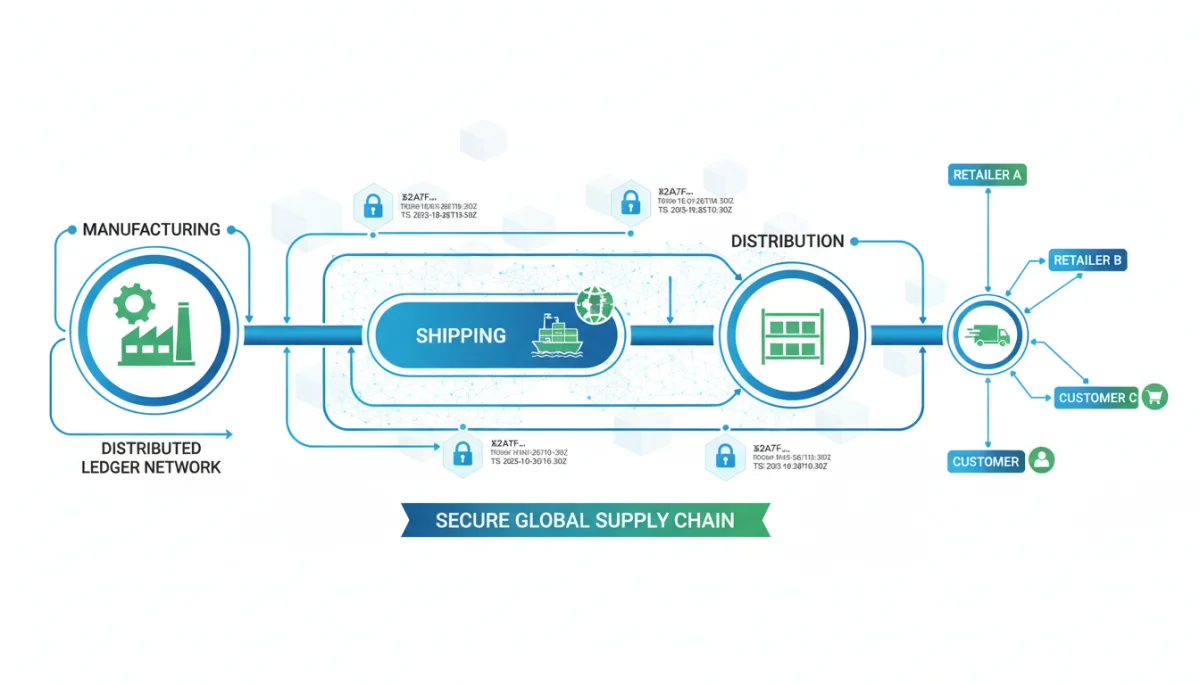
By providing a shared, immutable ledger, all parties involved in the manufacturing process can access real-time information about components, raw materials, and finished goods, leading to better planning and reduced waste.
Predictive Maintenance and Quality Control
Sensors on equipment can feed data directly to the blockchain, enabling predictive maintenance and ensuring optimal performance. This data can also be used to verify the quality of components at every stage of production.
Smart contracts, automated agreements executed on the blockchain, can trigger payments or orders when certain conditions are met, further streamlining processes and reducing administrative overhead. This level of automation drives significant cost savings and operational efficiencies.
- Component Tracking: Records the origin and specifications of every part used.
- Automated Payments: Smart contracts facilitate instant, secure transactions upon delivery.
- Demand Forecasting: Improved data sharing leads to more accurate predictions.
- Waste Reduction: Better inventory visibility minimizes overstocking and obsolescence.
The integration of blockchain into manufacturing workflows promises a future where supply chains are not only more efficient but also more resilient to disruptions, capable of adapting quickly to changing market demands and unforeseen challenges.
Revolutionizing Global Shipping and Logistics
International shipping is notoriously complex, involving numerous intermediaries, extensive paperwork, and potential for delays and disputes. Blockchain technology can simplify these processes, enhancing transparency and reducing friction.
By digitizing documentation and creating a shared, secure record of shipments, blockchain can accelerate customs clearances, improve container tracking, and provide all stakeholders with a unified view of the logistics process.
Digitizing Documentation and Customs Procedures
Paper-based processes are a major source of inefficiency and error in global logistics. Blockchain allows for the creation of digital bills of lading, customs declarations, and other vital documents, all securely stored and accessible to authorized parties.
This digital transformation reduces administrative burdens, minimizes the risk of fraud, and significantly speeds up the movement of goods across borders. The result is a more agile and responsive global supply chain.
- Digital Bills of Lading: Replaces physical documents with secure, digital versions.
- Container Tracking: Real-time, tamper-proof tracking of cargo location and status.
- Automated Customs: Streamlines declaration processes and reduces delays.
- Dispute Resolution: Clear, immutable records aid in resolving discrepancies quickly.
The benefits extend beyond mere efficiency. Enhanced security means less risk of theft or tampering, and improved communication among partners fosters stronger, more reliable business relationships in the intricate world of global trade.
Enhancing Ethical Sourcing and Sustainability Initiatives
Consumers and regulators increasingly demand ethical and sustainable practices throughout the supply chain. Blockchain provides the transparency needed to verify claims related to labor practices, environmental impact, and responsible sourcing.
This technology can create an unalterable audit trail for materials, from their extraction or production to their final product integration, ensuring that companies can credibly demonstrate their commitment to sustainability.
Verifying Labor Practices and Environmental Compliance
From conflict minerals to fair labor conditions, blockchain can track the provenance of raw materials and components, providing verifiable evidence of compliance with ethical standards. This helps brands build trust with conscious consumers.
Environmental impact data, such as carbon emissions or water usage, can also be logged onto the blockchain, allowing companies to accurately report their sustainability efforts and identify areas for improvement.
- Conflict-Free Materials: Verifies the origin of raw materials to prevent illegal sourcing.
- Fair Labor Standards: Records compliance with ethical labor practices at every stage.
- Carbon Footprint Tracking: Monitors and verifies environmental impact data.
- Circular Economy Support: Facilitates tracking of reusable and recyclable components.
By making sustainability efforts transparent and auditable, blockchain empowers businesses to not only meet regulatory requirements but also to genuinely differentiate themselves in a market that highly values corporate social responsibility. This shift is crucial for building long-term brand equity and consumer loyalty.
Securing Intellectual Property and Data Exchange
In complex supply chains, intellectual property (IP) and sensitive data are constantly exchanged among various partners, making security and ownership verification a significant concern. Blockchain offers a robust solution for protecting these invaluable assets.
By creating an immutable, timestamped record of IP creation and usage, blockchain can help prevent counterfeiting of designs, unauthorized use of patented processes, and secure the exchange of proprietary information.
Protecting Designs and Proprietary Information
Design specifications, manufacturing blueprints, and other critical IP can be registered on a blockchain, providing irrefutable proof of ownership and creation date. This deters infringement and simplifies legal recourse if violations occur.
Secure data exchange protocols built on blockchain ensure that sensitive information shared between partners remains confidential and is only accessible to authorized parties, maintaining competitive advantage and regulatory compliance.
- Timestamped IP Registration: Immutable proof of creation and ownership for designs and patents.
- Secure Data Sharing: Encrypted and permissioned access to sensitive manufacturing data.
- Anti-Counterfeiting: Verifies authenticity of branded products at every stage.
- Supply Chain Audits: Provides a transparent record for compliance and security checks.
The ability of blockchain to secure intellectual property and facilitate trustworthy data exchange is paramount in an interconnected world where digital assets are as valuable as physical goods. This provides a foundational layer of trust that underpins modern supply chain collaboration.
| Key Application | Brief Description |
|---|---|
| Food Safety & Traceability | Ensures farm-to-fork transparency, quick recalls, and authenticity verification for food products. |
| Pharmaceutical Authenticity | Combats counterfeit drugs by providing an immutable record of each medication’s journey. |
| Manufacturing Efficiency | Optimizes inventory, production, and quality control through real-time data sharing and smart contracts. |
| Ethical Sourcing | Verifies labor practices and environmental compliance, enhancing brand trust and sustainability. |
Frequently Asked Questions About Blockchain in Supply Chains
▼
Blockchain’s primary benefit is creating an immutable, transparent, and secure record of transactions and product movements. This enhances trust among partners, reduces fraud, and significantly improves efficiency and traceability from origin to consumer.
▼
By assigning unique digital identifiers to each drug unit and recording its entire journey on an immutable ledger, blockchain makes it nearly impossible for counterfeit products to enter the legitimate supply chain, ensuring authenticity and patient safety.
▼
Absolutely. Blockchain provides farm-to-fork traceability, allowing for rapid identification of contamination sources and precise recall management. This minimizes public health risks, reduces waste, and boosts consumer confidence in food products.
▼
Smart contracts are self-executing agreements stored on the blockchain. They automate processes like payments, inventory reordering, or quality checks when predefined conditions are met, streamlining operations and reducing manual intervention and potential errors.
▼
While large enterprises often lead adoption, blockchain solutions are becoming increasingly accessible to small and medium-sized businesses. Its modular nature allows for scalable implementation, benefiting companies of all sizes by enhancing trust and efficiency within their networks.
Conclusion
The journey of blockchain beyond its cryptocurrency origins into the realm of enterprise applications, particularly within US supply chains, marks a significant paradigm shift. By 2026, the foundational principles of immutability, transparency, and decentralization will have permeated various sectors, from food and pharmaceuticals to manufacturing and global logistics. The widespread adoption of blockchain is not merely an incremental improvement; it represents a fundamental re-architecture of how goods are tracked, verified, and delivered, promising a future of enhanced trust, unparalleled efficiency, and greater resilience across the entire supply chain ecosystem. Businesses that embrace these innovations will undoubtedly be at the forefront of this revolution, securing a competitive edge in an increasingly interconnected and demanding global market.
