Enhancing Business Agility: 4 Frameworks for Faster Market Response

Anúncios
To enhance business agility, organizations can adopt four key frameworks designed to accelerate market responsiveness by 30% by mid-2026, fostering innovation and maintaining a competitive edge in dynamic environments.
In today’s fast-paced business landscape, the ability to adapt quickly is paramount. This article explores how adopting specific frameworks can be instrumental in enhancing business agility: 4 frameworks to respond to market changes 30% faster by mid-2026, ensuring your organization not only survives but thrives.
Anúncios
Understanding the imperative for business agility
The global market is characterized by constant flux, driven by technological advancements, evolving consumer demands, and unforeseen disruptions. For businesses, this means that static strategies are no longer viable. The need for agility is not just a buzzword but a fundamental requirement for sustained success and competitive advantage.
Organizations must cultivate a culture and implement systems that allow for rapid sensing of market shifts and swift, effective responses. This proactive stance helps mitigate risks and capitalize on emerging opportunities, transforming potential threats into growth avenues. Neglecting agility can lead to stagnation, loss of market share, and ultimately, business failure.
Anúncios
The dynamic market landscape
- Technological disruption: New technologies constantly reshape industries, demanding quick adaptation.
- Consumer behavior shifts: Customer preferences evolve rapidly, requiring flexible product and service offerings.
- Global competition: Increased global connectivity means more diverse and intense competition.
- Economic volatility: Unpredictable economic cycles necessitate robust financial and operational flexibility.
The imperative for business agility extends beyond mere operational efficiency; it encompasses strategic foresight and organizational resilience. By embracing agility, companies can build a robust foundation that allows them to pivot decisively when circumstances dictate, ensuring long-term viability. This strategic approach ensures that resources are allocated effectively to address pressing needs and opportunities, preventing costly missteps.
Ultimately, understanding and prioritizing business agility means recognizing that change is the only constant. Organizations that embed agility into their DNA are better positioned to navigate complexity, innovate continuously, and achieve ambitious growth targets even in the most challenging environments.
Framework 1: Scaled Agile Framework (SAFe)
The Scaled Agile Framework (SAFe) provides a comprehensive approach for applying Lean-Agile principles across an entire enterprise. It helps large organizations synchronize alignment, collaboration, and delivery, ensuring that all teams are working towards common strategic objectives.
SAFe’s structured guidance allows businesses to maintain the benefits of agile development at scale, addressing the complexities that arise when multiple teams need to coordinate their efforts. It promotes continuous delivery and relentless improvement, essential for responding to market changes rapidly.
Implementing SAFe in large enterprises
Implementing SAFe typically involves several layers, from team-level execution to portfolio strategy. This multi-level approach ensures that agile practices are not confined to small teams but are integrated into the entire organizational fabric, fostering a unified response to market demands.
- Portfolio level: Defines strategic themes and allocates budgets to value streams.
- Large solution level: Coordinates multiple Agile Release Trains (ARTs) for large-scale solutions.
- Program level: Organizes teams into ARTs to deliver continuous value.
- Team level: Daily execution of work using Scrum or Kanban.
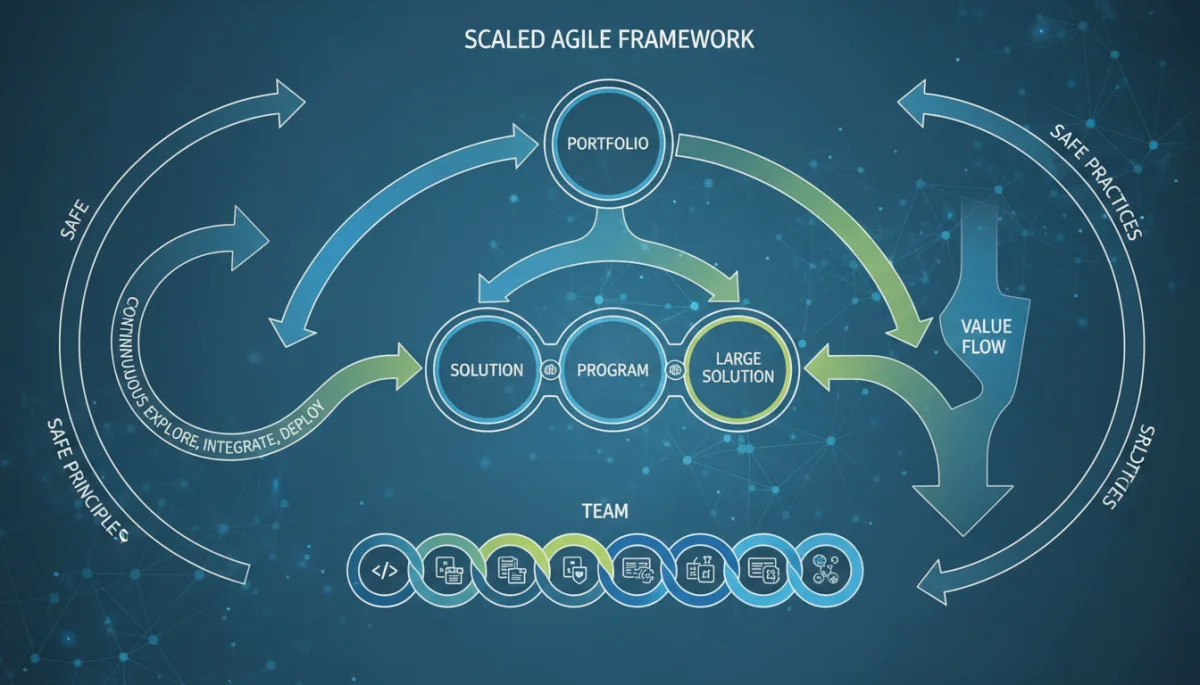
SAFe’s emphasis on transparency and continuous feedback loops allows organizations to quickly identify bottlenecks and adjust their course. This adaptability is crucial for achieving the goal of responding 30% faster to market changes. By breaking down work into smaller, manageable increments, SAFe enables quicker delivery of value and more frequent opportunities for stakeholder feedback.
The framework also encourages a Lean-Agile mindset, promoting decentralization of decision-making and empowering teams. This shift in organizational culture is vital for fostering innovation and ensuring that employees at all levels contribute to the company’s agile capabilities. Adopting SAFe can significantly improve an organization’s ability to align development with business goals, leading to more relevant and timely product releases.
Framework 2: Disciplined Agile (DA)
Disciplined Agile (DA) is a hybrid approach that provides context-driven process guidance, allowing organizations to choose their way of working (WoW). Unlike prescriptive frameworks, DA offers a toolkit of strategies and practices from various agile and lean methods, enabling teams to tailor their processes to specific situations.
This flexibility is a significant advantage in dynamic markets, as it allows businesses to optimize their approach rather than being constrained by a one-size-fits-all methodology. DA helps organizations make informed decisions about their processes, leading to more efficient and effective responses to market changes.
Tailoring processes with DA
DA recognizes that every team and every project is unique. It provides decision points and options for various aspects of software development and broader business operations, from inception to delivery and support. This guidance helps teams avoid common pitfalls and continuously improve their WoW.
- Goal-driven approach: Focuses on achieving specific outcomes rather than rigidly following steps.
- Context sensitivity: Adapts practices based on team size, domain complexity, and regulatory requirements.
- Hybrid methodology: Integrates elements from Scrum, Kanban, Lean, and SAFe.
- Continuous improvement: Encourages teams to regularly reflect and evolve their processes.
By empowering teams to choose the most appropriate practices, DA fosters a sense of ownership and accountability, which are critical for accelerating market response. The framework promotes an iterative and incremental approach, allowing for frequent adjustments based on feedback and new information. This continuous adaptation is key to staying ahead in competitive markets.
Disciplined Agile also emphasizes the importance of continuous learning and growth within the organization. It provides pathways for teams to mature their agile practices, leading to greater efficiency and higher quality outcomes. This iterative refinement of processes is fundamental to achieving the target of 30% faster market responsiveness.
Framework 3: Large-Scale Scrum (LeSS)
Large-Scale Scrum (LeSS) applies Scrum principles to multiple teams working together on a single product. It is designed to scale Scrum while maintaining its core values of transparency, inspection, and adaptation. LeSS focuses on de-scaling the organization rather than adding layers of complexity, making it a lean and efficient framework for large-scale agile development.
LeSS aims to simplify the organizational structure and processes, allowing for quicker decision-making and faster delivery of value. This simplicity is a powerful asset when the goal is to enhance business agility and respond rapidly to market shifts.
Simplifying large-scale development with LeSS
LeSS comes in two configurations: LeSS for up to eight teams and LeSS Huge for more than eight teams. Both configurations emphasize a single Product Backlog, a single Product Owner, and cross-functional teams, fostering a holistic view of the product and its development.
- One Product Backlog: Ensures a unified vision and prioritization across all teams.
- Shared understanding: Promotes collaboration and knowledge sharing among teams.
- Customer-centricity: Focuses on delivering value directly to the end-user.
- Organizational de-scaling: Reduces bureaucracy and increases team autonomy.
The LeSS framework encourages direct communication and collaboration among teams and stakeholders, minimizing handoffs and delays. This streamlined approach significantly reduces the time it takes to move from concept to delivery, directly contributing to faster market responsiveness. By empowering teams to self-organize and make decisions, LeSS unleashes their full potential for innovation.
Adopting LeSS helps organizations break free from the traditional command-and-control structures that often hinder agility. It promotes a culture of continuous learning and improvement, where teams are constantly seeking better ways to deliver value. This cultural shift, combined with streamlined processes, makes LeSS an effective framework for achieving the ambitious goal of 30% faster market response.
Framework 4: Nexus
Nexus is a framework for scaling Scrum that focuses on integrating the work of multiple Scrum teams into a single, cohesive product. Developed by Scrum.org, Nexus emphasizes minimizing dependencies and maximizing transparency across teams to ensure that they can deliver an integrated increment every Sprint.
The primary goal of Nexus is to reduce the complexity inherent in multi-team Scrum environments, allowing organizations to maintain the speed and flexibility of individual Scrum teams while working on a larger product. This integration is crucial for enhancing business agility and ensuring a unified, rapid response to market changes.
Integrating multiple Scrum teams with Nexus
Nexus introduces a Nexus Integration Team (NIT) which is responsible for ensuring that all Scrum teams are working towards a common goal and that their work integrates smoothly. This team helps identify and resolve integration issues early, preventing costly delays and rework.
- Nexus Integration Team: Facilitates integration and resolves cross-team dependencies.
- Integrated Increment: Ensures a working, integrated product is delivered each Sprint.
- Dependency management: Proactive identification and resolution of inter-team dependencies.
- Scaled events: Extends Scrum events like Sprint Planning and Daily Scrum to the Nexus level.
By providing clear guidelines for scaling Scrum, Nexus helps organizations maintain their agile momentum even as their product and team sizes grow. The framework’s emphasis on frequent integration and transparency ensures that potential issues are identified and addressed quickly, preventing them from escalating into major problems. This proactive problem-solving is vital for achieving rapid market responsiveness.
Nexus empowers teams to collaborate effectively, fostering a shared understanding of the product and its development. This collective ownership and focus on integration allow organizations to deliver high-quality products faster and more consistently. Implementing Nexus can significantly contribute to an organization’s ability to react swiftly to market demands, moving closer to the target of 30% faster response times.
Choosing the right framework for your organization
Selecting the most suitable agile framework is a critical decision that depends heavily on an organization’s specific context, size, culture, and strategic goals. There is no one-size-fits-all solution; what works for one company might not be ideal for another. A careful evaluation of each framework’s strengths and weaknesses against your organizational needs is essential.
Consider factors such as the number of teams, the complexity of your product, regulatory requirements, and the existing level of agile maturity within your organization. A thorough assessment will guide you towards a framework that can truly enhance your business agility and accelerate your response to market changes.
Key considerations for framework selection
When evaluating frameworks, it’s important to look beyond theoretical benefits and consider practical implications. Pilot programs and expert consultation can provide valuable insights into how a framework might perform within your unique environment.
- Organizational size and complexity: Larger, more complex organizations might benefit from SAFe, while smaller multi-team setups might prefer LeSS or Nexus.
- Existing agile maturity: Organizations new to agile might need more prescriptive guidance, while experienced teams might thrive with the flexibility of DA.
- Product complexity and dependencies: Frameworks like Nexus are excellent for managing integration across multiple teams working on a single product.
- Cultural fit: The chosen framework should align with or help foster the desired organizational culture of collaboration and continuous improvement.
Ultimately, the goal is to implement a framework that facilitates continuous learning and adaptation. The best framework is one that can evolve with your organization and the market, ensuring sustained agility. It should empower your teams, streamline your processes, and ultimately drive your business towards achieving a 30% faster response rate to market changes by mid-2026.
Making an informed decision about the right framework involves understanding your current state, envisioning your desired future state, and selecting the path that best bridges that gap. This strategic choice is a cornerstone of successful business agility transformation.
Measuring impact and continuous improvement
Implementing an agile framework is only the first step; continuously measuring its impact and striving for improvement are equally vital. Organizations must establish clear metrics to track progress towards their agility goals, such as the 30% faster market response target. Without robust measurement, it’s impossible to determine the effectiveness of the chosen framework or identify areas for refinement.
Continuous improvement is an inherent principle of agile methodologies. It involves regular retrospectives, feedback loops, and a willingness to adapt processes based on empirical evidence. This iterative approach ensures that the organization remains flexible and responsive, constantly optimizing its ability to react to market dynamics.
Key metrics for agility
Effective measurement goes beyond simple output metrics. It involves understanding the speed, quality, and adaptability of your processes. These insights allow for data-driven decisions that propel the organization closer to its agility objectives.
- Lead time and cycle time: Measure the time from idea inception to delivery, indicating speed.
- Release frequency: How often new features or products are deployed, reflecting adaptability.
- Customer satisfaction: Gauges how well market needs are being met, indicating responsiveness.
- Employee engagement: Reflects the health of the agile culture and team effectiveness.
- Time to market for new products/features: Directly tracks the speed of market response.
Establishing a culture of continuous learning and experimentation is paramount for sustained agility. This means encouraging teams to try new approaches, learn from failures, and share best practices across the organization. Regular reviews of these metrics, combined with qualitative feedback, provide a holistic view of the agility journey.
By diligently measuring impact and committing to continuous improvement, organizations can ensure that their chosen framework not only meets but exceeds the goal of enhancing business agility. This ongoing commitment to evolution is what truly differentiates market leaders in a competitive landscape, enabling them to consistently respond faster and more effectively to change.
| Key Framework | Brief Description |
|---|---|
| SAFe | Comprehensive framework for large-scale Lean-Agile development across the enterprise. |
| Disciplined Agile (DA) | Hybrid, context-driven toolkit allowing organizations to choose their optimal way of working. |
| LeSS | Applies Scrum principles to multiple teams on a single product, emphasizing de-scaling. |
| Nexus | Scales Scrum by integrating multiple Scrum teams to deliver a cohesive product increment. |
Frequently Asked Questions about Business Agility Frameworks
Business agility is an organization’s ability to adapt quickly and effectively to changes in the market, customer demands, and technological advancements. It is crucial for survival and growth in dynamic environments, enabling faster innovation, improved customer satisfaction, and sustained competitive advantage.
These frameworks streamline processes, improve cross-functional collaboration, and promote continuous feedback loops. By breaking down large projects into smaller, manageable increments and fostering a culture of rapid adaptation, they enable organizations to detect market shifts and deploy effective solutions much more quickly than traditional methods.
For smaller to medium-sized businesses, LeSS or Nexus might be more suitable as they focus on scaling Scrum effectively without adding excessive complexity. Disciplined Agile (DA) also offers flexibility to tailor processes, which can be beneficial for organizations with specific needs and limited resources, allowing for a customized approach.
Yes, organizations often adopt a hybrid approach, taking best practices from various frameworks to create a custom methodology that fits their unique context. Frameworks like Disciplined Agile (DA) are designed with this flexibility in mind, offering a toolkit for choosing the optimal way of working rather than prescribing a rigid set of rules.
Key challenges include resistance to change within the organization, lack of leadership buy-in, insufficient training, and difficulty in aligning existing processes with new agile methodologies. Overcoming these requires strong leadership, clear communication, and a sustained commitment to cultural transformation and continuous learning.
Conclusion
The journey towards enhancing business agility is not merely about adopting a new process; it’s about fundamentally transforming how an organization perceives and responds to change. The four frameworks discussed—SAFe, Disciplined Agile, LeSS, and Nexus—each offer distinct pathways to achieving greater responsiveness and resilience. By strategically implementing one or a hybrid of these approaches, businesses can significantly accelerate their ability to adapt to market changes, potentially achieving a 30% faster response rate by mid-2026. This proactive stance ensures continued innovation, competitive advantage, and long-term success in an ever-evolving global landscape.
